
No Cover
Can't Hurt Me
David Goggins
Goggins brings the same no-excuses intensity as Cardone, arguing that most people use a fraction of their capacity and showing how pushing past comfort unlocks far bigger results.
Reader-supported: when you buy through links on our site, we may earn an affiliate commission. Learn more
We earn a commission if you buy through these links. Learn more
Find Similar BooksGuide by the Books of the Day editors · Updated · How we write our guides
Cardone's case for Massive Action is a blunt, high-energy push to stop settling for normal effort, most useful as a motivational jolt for people already willing to work hard.
2 creators reviewed The 10X Rule on YouTube between 2016 and 2019, with 569.9K views between them. Their opinions are their own; we picked these reviews, we didn't write them.
The 10X Rule is a motivational business book built around one claim: most people operate in three modes, doing nothing, pulling back from risk, or doing the expected amount, and results stay ordinary until you add a fourth mode that Cardone calls Massive Action. He describes it as relentless, oversized effort that keeps going after the first attempt, with each step followed by more action rather than a pause to evaluate. The book is written as a series of direct instructions rather than a collection of case studies, aimed at people who already want big outcomes in sales, entrepreneurship, or investing.
Cardone writes in the voice of a seasoned salesman and real estate investor, so much of the material draws on his own experience and on people he has worked with. The tone is loud, repetitive, and confident. Ideas such as setting goals far larger than feels comfortable, and sizing effort against targets through his Estimation of Effort idea, recur across chapters with new anecdotes rather than deeper analysis.
Reading it feels less like studying a framework and more like sitting through a long pep talk. Some readers find that jolt useful for breaking inertia; others find the thin evidence and sales-pitch rhythm wearing. Expect a fast read full of emphasis, with a few practical tactics buried inside the attitude.
Cardone argues that most people live in no action, retreat, or normal action, and that normal action is exactly why results stay average. The book's central move is to name a fourth degree, Massive Action, as the level where ambitious goals become reachable. Whether you accept the framing or not, it gives a clear vocabulary for noticing how often you coast at the expected level.
The key practical instruction is to follow every action with more action instead of waiting for results or a comfortable moment to reassess. The book treats this as a discipline you build over time, not a single burst of energy. Readers who struggle with starting and then stalling will find this the most directly usable part.
Cardone's 10X idea asks you to aim roughly ten times higher than feels reasonable, on the theory that ordinary effort falls short of such targets and forces different methods. The logic is motivational more than analytical. It works best as a prompt to question your ceiling, and it is less helpful if you need a realistic plan for a specific goal.
The book challenges the idea that better scheduling is the core fix for unproductive work, and proposes estimating the effort a goal requires so that targets are sized to results. The Estimation of Effort approach is presented with more confidence than its method supports. Still, the question of how much effort a goal truly takes is worth asking.
A large share of the book diagnoses fear of failure, risk aversion, and the habit of settling for average as the reasons people stop short of their goals. The writing is at its most engaging here, because it speaks to a familiar pattern. Its prescriptions are more about mindset than about specific tools for overcoming the obstacles it describes.
Critics often note that the book leans heavily on the author's own success and on anecdotes rather than systematic evidence, so its claim that a particular level of action guarantees results cannot be tested. The advice to keep acting without pause can underplay financial risk, health costs, plain bad luck, and the value of stopping to reassess a plan. Repetition is a frequent complaint, and the sales-driven tone may feel dated or abrasive to readers outside sales. Its practical tools are thinner than its framing suggests.
Book details and cover from Google Books.
Ready to read The 10X Rule?
Get your copy on Amazon, or listen to it on Audible. We earn a commission if you buy through these links.
David Goggins
Goggins brings the same no-excuses intensity as Cardone, arguing that most people use a fraction of their capacity and showing how pushing past comfort unlocks far bigger results.
Jocko Willink, Leif Babin
Like The 10X Rule's insistence that you alone are responsible for outcomes, these Navy SEAL leaders hammer home total accountability with practical business applications.
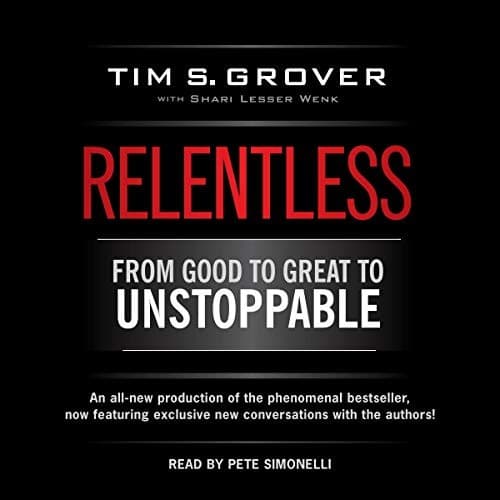
Tim Grover, Tim S. Grover
Michael Jordan's trainer describes the obsessive drive of elite performers, echoing Cardone's view that extreme success demands an almost unreasonable hunger and refusal to settle.
David Schwartz
A classic forerunner to Cardone's message: setting larger goals and believing you can reach them changes the actions you take and the results you get.