
A Brief History of Time
Stephen Hawking
Hawking wrote the introduction to Thorne's book, and his own classic covers black holes, the big bang and time's arrow in a shorter, more conversational way.
Reader-supported: when you buy through links on our site, we may earn an affiliate commission. Learn more
We earn a commission if you buy through these links. Learn more
Find Similar Booksby Kip S Thorne
Guide by the Books of the Day editors · Updated · How we write our guides
Kip Thorne, a working relativity physicist, walks you through black holes, time warps and the question of whether nature allows time travel, showing his reasoning as well as his conclusions.
2 creators reviewed Black Holes and Time Warps on YouTube between 2023 and 2025, with 2.3K views between them. Their opinions are their own; we picked these reviews, we didn't write them.
Black Holes and Time Warps is Kip Thorne's account of general relativity and the strange objects it predicts, written for general readers in 1994. Its core subject is the physics of collapsed stars and the warped geometry of spacetime, but the book keeps widening out: into the history of how Einstein's theory was doubted and then vindicated, into the people who shaped the field, and into the question of whether the laws of physics permit time travel.
Thorne writes as a working researcher, so the book reads more like a guided tour of a physicist's thinking than a textbook. He explains why relativity suggests that sufficiently dense matter must collapse into a black hole, how astronomers came to believe such objects exist, and why theorists took seriously ideas like wormholes and machines for traveling into the past. Much of the appeal is the candor: he separates what is well tested from what is plausible and what is speculation.
Expect a demanding but rewarding read. The prose is clear and conversational, and equations are kept mostly out of the main text, but you need patience with unfamiliar ideas like curved spacetime and the causal structure of the universe. It is less a tidy summary of settled facts than a snapshot of a field in motion, which is part of its charm.
Einstein's central insight is that gravity is not a force pulling across empty space but the curvature of spacetime itself, with matter telling spacetime how to bend and bent spacetime telling matter how to move. Thorne builds this picture patiently, so that later claims about black holes and time warps feel like consequences rather than tricks of language.
The book follows the reasoning that a star massive enough, once its fuel is spent, cannot be held up by any known pressure and keeps shrinking. Thorne shows why this leads to a boundary beyond which light cannot escape, and why the resulting objects were once treated with suspicion before observations made them hard to dismiss.
Thorne discusses hypothetical shortcuts through spacetime and what would be needed to keep them open, including exotic forms of matter that may not exist. The discussion is less about whether time machines are practical and more about whether the laws of physics forbid them, a question he treats as a serious scientific problem rather than a thought experiment for fun.
Perhaps the book's most lasting lesson is about method. Thorne repeatedly asks how much confidence a claim deserves, which predictions have been tested, and where theory has run ahead of evidence. Readers who care about how scientific knowledge is built, not only what it currently says, will find this the most useful thread.
The book was written in 1994, before the first direct detection of gravitational waves in 2015 and the first image of a black hole's shadow in 2019, so its observational picture is dated even where its theory holds up. Its wormhole and time travel chapters are openly speculative, and some readers find them tangential to the main story. The historical narrative also leans toward the physicists Thorne knew personally, so the account of the field's development is shaped by his vantage point.
Book details and cover from Google Books.
Ready to read Black Holes and Time Warps?
Get your copy on Amazon, or listen to it on Audible. We earn a commission if you buy through these links.
Stephen Hawking
Hawking wrote the introduction to Thorne's book, and his own classic covers black holes, the big bang and time's arrow in a shorter, more conversational way.
Janna Levin
A compact, lyrical tour of what black holes actually are, ideal if you enjoyed Thorne's thought experiments about falling toward an event horizon.
Leonard Susskind
Picks up where Thorne's story of Hawking radiation leaves off, recounting Susskind's long argument with Hawking about information loss, with the same insider flavour.
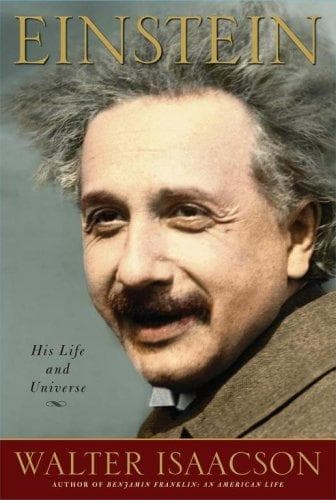
Walter Isaacson
Thorne's book opens with Einstein's struggle toward general relativity; this biography fills in the man, his reasoning and his rivalries in rich detail.