
We earn a commission if you buy through these links. Learn more
Einstein
Guide by the Books of the Day editors · Updated · How we write our guides
Isaacson's long biography makes Einstein's scientific breakthroughs understandable while showing the stubborn, contradictory man behind the equations, drawing on his own letters and papers.
What Creators Say About Einstein
2 creators reviewed Einstein on YouTube between 2020 and 2021, with 6.2K views between them. Their opinions are their own; we picked these reviews, we didn't write them.
What It's About
Isaacson's book is a full-length biography of Albert Einstein, from his boyhood in Germany and his years as a patent clerk in Bern through the development of relativity, his fame, his emigration to the United States, and his last decades at Princeton. It follows the chronological arc most readers expect, but it gives nearly equal weight to the person and the physics. It leans heavily on Einstein's correspondence and documents, which show him arguing, joking, and sometimes being wrong.
The approach is narrative and steady rather than academic. Isaacson explains the core ideas in plain language, using analogies and short passages of reasoning, so a reader without a physics background can follow the logic of special and general relativity at a basic level. The science is not reduced to slogans, but you will not get the full mathematics.
The experience is that of a long, immersive read. Political material, including Einstein's pacifism, his response to the rise of Nazism, and his role in encouraging American atomic research, sits alongside family life, friendships, and his later search for a unified field theory that he pursued largely in isolation. The result is less a hagiography than an extended portrait of a man whose stubbornness was part of his genius.
Read this if you…
- want a complete life of Einstein that gives the science and the person equal attention
- are curious how a patent clerk's thought experiments became relativity, and want the ideas explained without equations
- want to understand Einstein's public role in politics and the atomic age
Skip it if you…
- want a technical guide to relativity or the mathematics behind it
- are looking for a short introduction or a portrait focused only on the physics
Key Ideas
- 1
Imagination as the engine of discovery
Isaacson presents Einstein's breakthroughs as coming largely from thought experiments, such as imagining what a beam of light looks like to a rider moving alongside it, rather than from laboratory work. He traces how these mental pictures, checked against known physics, led to special relativity and later general relativity. The book makes clear that Einstein was not a skilled experimenter and that his method was mostly careful reasoning about what must be true.
- 2
A miracle year and the patent office
The book describes 1905, when Einstein published several papers that reshaped physics, while he worked as a patent examiner in Bern. That steady job gave him time to think without an academic post. Isaacson uses this stretch to show how an outsider with few institutional connections could produce work that changed how scientists understood light, motion, and matter.
- 3
Politics, pacifism, and the atomic bomb
Isaacson treats Einstein as a public figure whose opinions on war, Zionism, civil liberties, and nuclear weapons carried real weight. He shows Einstein's regret over the 1939 letter urging American nuclear research and his later campaigning against the bomb. Readers see how fame magnified his views and how uneasy he often was in the role of conscience for the world.
- 4
Character, contradiction, and personal cost
Isaacson does not hide the damage Einstein's absorption in work caused his family, including the breakdown of his first marriage, the difficulties with his sons, and his often distant manner with those close to him. The book argues that the same single-mindedness that drove his science also made him hard to live with, and it asks readers to weigh both sides.
Limitations
Some readers find the book long, and its pace slows during the political and later-life sections, which cover many events without deep analysis. Its science is clear but simplified, so anyone wanting the mathematics of general relativity or a sharper account of quantum theory will need another book. Isaacson relies mainly on published sources and Einstein's letters, so historians may want more on his colleagues and on the contribution of his first wife, Mileva Maric, which remains debated. Written in 2007, it predates later archival volumes and scholarship.
Questions Readers Ask
- Do I need a physics background to understand this book?
- No, but some patience helps. Isaacson explains relativity and the photoelectric effect in plain language, using analogies and small thought experiments. You will come away with a good conceptual grasp of what Einstein proposed and why it mattered, though you will not be able to do the calculations yourself.
- How does it compare to Abraham Pais's Subtle Is the Lord?
- Pais's book is more technical and concentrates on the science and how Einstein's ideas developed. Isaacson gives you more of the life, including politics, family, and character, and his writing is more accessible. Readers who want both the story and a deeper look at the physics often read the two together.
- Is it still worth reading?
- Yes. The core story of Einstein's life and work has not changed, and Isaacson's narrative remains one of the most readable overviews available. Some specific episodes have been refined by later archival research, so treat it as a strong starting point rather than the final word.
- Published
- 2007
- ISBN
- 9788441540378
- Difficulty
- intermediate
- Category
- Science
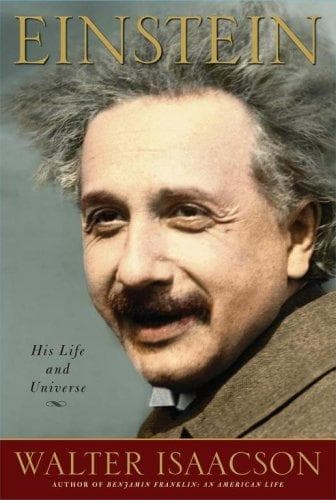
Book details and cover from Google Books.
Ready to read Einstein?
Get your copy on Amazon, or listen to it on Audible. We earn a commission if you buy through these links.