
We earn a commission if you buy through these links. Learn more
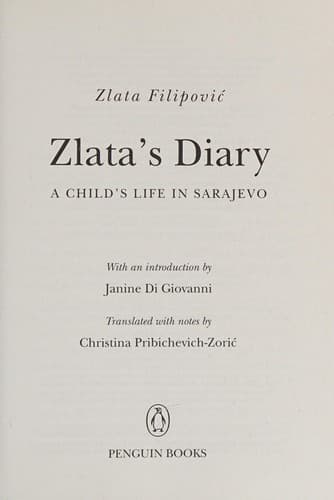
Zlata's Diary
Guide by the Books of the Day editors · Updated · How we write our guides
A child's wartime diary from Sarajevo that shows the siege through ordinary school days, friendships and fear, offering a rare firsthand view that is short but hard to forget.
What Creators Say About Zlata's Diary
2 creators reviewed Zlata's Diary on YouTube between 2011 and 2025, with 19.6K views between them. Their opinions are their own; we picked these reviews, we didn't write them.
What It's About
Zlata's Diary collects entries written by Zlata Filipovic, a girl in Sarajevo who received a diary for her tenth birthday in 1991, just as Yugoslavia was coming apart. The entries cover roughly two years. At first the diary is about school, friends, birthdays and the small dramas of growing up. As the city comes under siege, it becomes a record of shelling, cut-off utilities, nights spent in basements and people leaving or dying.
The style is plain and direct, the way a child writes. Zlata jumps between jokes, complaints about homework, frustration with grown-ups and real terror, often within the same page. There is no retrospective adult voice explaining what it all meant. The power comes from the gap between ordinary preoccupations and extraordinary conditions. The English edition adds some context around the entries, so the history arrives in compact form rather than woven throughout.
Reading it is quick but emotionally heavy. Most readers finish it in a sitting or two and then need a while before picking up something else. It is a primary source rather than a full history of the war, so it works best as a companion to broader accounts.
Read this if you…
- want a firsthand picture of the Bosnian war from someone who lived through it
- are interested in how children experience fear, loss and everyday life during a siege
- want a short, accessible book that still hits hard
Skip it if you…
- need a political or military explanation of why the war happened and who was responsible
- want a polished literary memoir with a reflective adult narrator looking back
Key Ideas
- 1
Ordinary life under extraordinary pressure
The book's central effect comes from watching school, birthdays, music and friendship continue in a city being shelled. Zlata keeps returning to routines because they are what still feel real. The contrast shows how a war reaches into the most mundane parts of life long before it reaches the front lines of anyone's thinking.
- 2
A child's view of the siege
Zlata notices what adults often miss or hide: the sound of shells, the rationing of food and water, the decisions her family makes about whether to stay. She does not understand the politics, and the book does not pretend she does. That limited view is what makes the reader feel the danger as a child would.
- 3
The diary as a way to keep going
Writing gives Zlata a place to put fear, anger and boredom and a sense that her own voice still matters. Reading it, you see how a private habit can become a form of survival. The act of recording also gives the book its structure, since each entry is dated and the passing of months is felt.
- 4
A shrinking world of friends
Over time, people she knows leave the city or are killed, and her circle of friends and places contracts. The diary tracks this loss in small, specific details rather than summary. Many readers find these quiet notes of absence more affecting than the descriptions of violence.
Limitations
The book is one child's perspective, shaped by her age and by what she could see from her own home and school. It does not explain the wider conflict, its causes or its outcome, and it stops before the war fully ends, so the aftermath is absent. Because it is a published diary, it has been edited and translated, so some of the original voice is filtered. Some readers find the repetitive, childlike style slow or the constant worry tiring, and others feel it lacks the depth of adult wartime memoirs.
Questions Readers Ask
- Is Zlata's Diary suitable for younger readers?
- Many teenagers read it, and it is often assigned in schools. The content is honest about shelling, hunger, and the deaths of people Zlata knows, so it can be upsetting. A parent or teacher may want to read it alongside a younger child and be ready to talk about what it describes.
- How does it compare to The Diary of a Young Girl by Anne Frank?
- Both are wartime diaries by young writers, and both are read as primary sources about Europe in the 1940s and 1990s. Anne Frank's diary is more reflective and introspective, written in hiding with a growing sense of confinement. Zlata's covers an open city under siege, so her entries are more exposed to shelling and everyday disruption, and they are more concrete and less philosophical.
- Published
- 1994
- ISBN
- 9780439044813
- Difficulty
- beginner
Book details and cover from Google Books.
Ready to read Zlata's Diary?
Get your copy on Amazon, or listen to it on Audible. We earn a commission if you buy through these links.