
We earn a commission if you buy through these links. Learn more
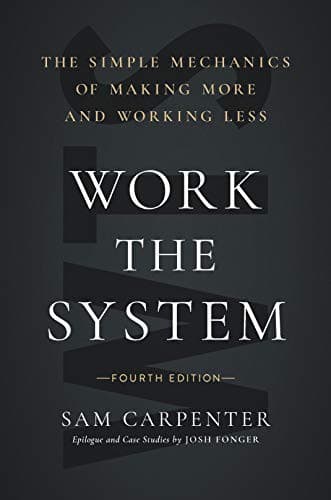
Work the system
A blunt, short case that a small business should run on written systems rather than its owner, useful if you are stuck doing everything yourself.
What It's About
Work the System is a short business book by Sam Carpenter, who argues that the usual small-business trap is that the owner becomes the most important employee, the one who has to be present for every decision and every fix. Carpenter's remedy is to build a company that runs on documented, repeatable processes, so that the owner can step back, take time away, and still trust that work is done properly.
The style is practical rather than theoretical. Carpenter writes from his own operation, so the advice comes with the texture of everyday problems: missed follow-ups, sloppy hand-offs, staff waiting to be told what to do next. The book is quick to read and leans on plain rules and examples rather than frameworks or charts. It feels less like an academic text and more like a long conversation with an operator who has already made the mistakes.
Reading it feels like being asked a series of uncomfortable questions about your own company. Some readers will find the directness energizing; others will find it repetitive and occasionally preachy. Either way, the test it leaves you with is simple: if you had to be gone for a month, would the business still work?
Read this if you…
- want to reduce how much of your business depends on you personally
- run or plan to run a service business built on repeatable tasks and a team
- prefer short, blunt, practical advice over research or theory
Skip it if you…
- run a creative or knowledge-based practice where every job is largely unique
- want a rigorous, data-driven management book with case studies and evidence
Key Ideas
- 1
The owner should not be the system
The book's central claim is that a business becomes fragile when its daily functioning depends on one person. Carpenter encourages owners to look at how much of the operation runs through them and to treat that dependence as a problem to be engineered away, not as a badge of commitment.
- 2
Fix the process, not the person
When something goes wrong, the instinct is to blame the employee who dropped the ball. Carpenter pushes readers to ask where the procedure left a gap that allowed the error. This shifts attention from scolding people to improving the way work is structured, which tends to prevent the same failure from recurring.
- 3
Write down how work actually gets done
Documentation is the mechanism that makes a system possible. Carpenter's point is that written procedures let others perform tasks consistently without asking you, and that the discipline of writing them exposes the vague spots in how you operate. The practical value lies in making quality repeatable across people and time.
- 4
Keep simple measures to see problems early
A system that runs without you still needs a way to show whether it is working. The book stresses watching a few clear indicators so that problems surface without you standing over anyone. The emphasis is on simplicity: a handful of numbers you actually check beats an elaborate reporting structure nobody reads.
Limitations
The book rests mainly on the author's own experience and on anecdotes rather than systematic evidence, so its claims are hard to test against other kinds of businesses. Its model fits operations with repeatable work far better than consulting, design, or software, where judgment matters more than procedure. Some readers find the tone repetitive and the advice more prescriptive than the situations they face. Specific tools and workplace norms have also changed since it was written, so the examples may feel dated even though the core logic holds up.
Questions Readers Ask
- Is Work the System still relevant?
- The core ideas about documenting processes, delegating with clear procedures, and not making yourself the bottleneck remain sound and widely shared today. The examples and tone reflect an older small-business environment, so treat the principles as the lasting part and the specifics as illustrations that may need translating to current tools.
- Who is this book best suited to?
- It suits owners and managers of businesses with staff who handle repeatable work and who feel trapped in daily operations. Solo freelancers and people in highly specialized fields will get less out of it, since much of their work cannot be reduced to a fixed procedure.
- Published
- 2008
- ISBN
- 9798886453201
- Difficulty
- beginner
- Category
- Business
Book details and cover from Google Books.
Ready to read Work the system?
Get your copy on Amazon, or listen to it on Audible. We earn a commission if you buy through these links.