
We earn a commission if you buy through these links. Learn more
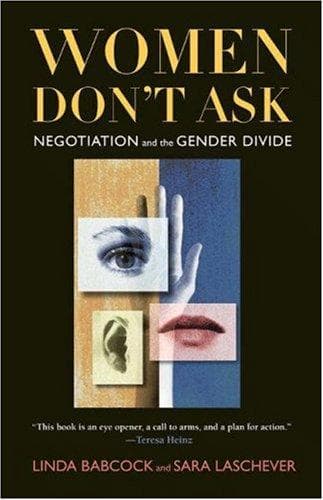
Women Don't Ask
by Sara Laschever, Linda Babcock
Guide by the Books of the Day editors · Updated · How we write our guides
A practical, research-based case that many women lose pay and opportunities simply by not asking, with concrete approaches for raises, offers, and everyday requests.
What Creators Say About Women Don't Ask
2 creators reviewed Women Don't Ask on YouTube between 2017 and 2021, with 154 views between them. Their opinions are their own; we picked these reviews, we didn't write them.
What It's About
Women Don't Ask, by Linda Babcock and Sara Laschever, starts from a simple observation: men initiate negotiations over pay, promotions, and assignments far more often than women do, and those gaps add up over a career. Babcock's economics research and the authors' interviews form the backbone of the argument. The book explores why this happens, pointing to how many women are raised to be agreeable and how asking can carry real social costs for women in a way it often doesn't for men.
The tone is practical rather than academic. The book moves from diagnosis to tools: preparing before a conversation, framing a request so it doesn't read as aggressive, handling pushback, and deciding when a request is worth making. Sample language and worked examples make the advice concrete, and the book extends beyond salaries to requests at home and in personal life.
Reading it feels like sitting with a direct, encouraging coach rather than a theorist. It is short and quick to get through, and many readers finish with a specific request they plan to make. Expect motivation and scripts more than deep theory or a full treatment of structural inequality.
Read this if you…
- you are early or mid-career and suspect you have been underpaid or passed over for raises
- you want scripts and specific phrasing for salary talks and everyday requests
- you tend to avoid asking for things at work or at home and want a push to start
Skip it if you…
- you want a rigorous, up-to-date analysis of the gender pay gap and its causes
- you already negotiate confidently and are looking for advanced, senior-level tactics
Key Ideas
- 1
Not asking has a compounding price
The core claim is that a single unnegotiated starting salary or unrequested raise is not a small thing. Because later raises are often calculated as percentages of current pay, an early gap can grow over years. The book uses this logic to show why occasional hesitation is more expensive than it looks in the moment.
- 2
Socialization shapes what women expect
The authors argue that many women learn early to prize cooperation, modesty, and not making a fuss. These habits can make women less likely to see a situation as negotiable at all. Recognizing this learned reflex is presented as the first step, since you cannot change a default you haven't noticed.
- 3
Asking can carry social backlash
The book takes seriously the fact that women who push for themselves may be judged as demanding or unlikable, while the same behavior in men is often read as confidence. Rather than telling women to ignore this, it suggests ways to ask that reduce the risk, such as stressing shared goals and the value you bring.
- 4
Preparation and framing make requests work
A large share of the practical advice centers on research, rehearsal, and phrasing. Knowing your market value, anticipating objections, and presenting a request as a problem to solve together are the main tools. The emphasis is on making a request easy to say yes to, not on being forceful.
Limitations
The book's research and examples are rooted in the early 2000s and mostly in a US professional context, so some figures and workplace norms have shifted. It leans heavily on individual strategy, which some critics say places too much responsibility on women rather than on employers and pay systems. Readers looking for a broad account of structural bias, or for evidence from outside the US, will need other sources.
Questions Readers Ask
- Is Women Don't Ask still relevant today?
- Yes, the core habits it describes, like hesitating to ask and not preparing before a salary conversation, remain common. However, some data and workplace examples are dated. Treat the scripts and mindset advice as the lasting value, and check current pay data separately before any negotiation.
- How does it compare to Ask for It by the same authors?
- Ask for It, the authors' follow-up, is generally seen as a more personal and practical companion that revisits the same themes with more emphasis on everyday requests and self-advocacy. If you read only one, Women Don't Ask gives the stronger foundation for the underlying argument.
- Published
- 2003
- ISBN
- 9780691089409
- Difficulty
- beginner
- Category
- Business
Book details and cover from Google Books.
Ready to read Women Don't Ask?
Get your copy on Amazon, or listen to it on Audible. We earn a commission if you buy through these links.