
We earn a commission if you buy through these links. Learn more
Wild seed
Octavia E. Butler's Wild Seed pairs an ancient, controlling immortal with a shapeshifting healer, and turns their uneasy bond into a sharp study of power, love, and survival across centuries.
What It's About
Wild Seed follows two figures across generations: Doro, an ancient being who has spent millennia breeding people for particular abilities, and Anyanwu, a woman who can change her shape and heal others. Their long, uneasy relationship drives the book, and Butler keeps the stakes personal rather than epic. Anyanwu is no passive partner. She is intelligent, proud, and as capable of resistance as Doro is of control.
Butler writes with a plain, unhurried directness. The story moves from West Africa to colonial America, and the realities of slavery, family, and survival are present throughout rather than decorative. The narrative skips across decades, so you feel time passing and the cost of it on the characters. Violence occurs, and some scenes are hard to read, but the book rarely turns sensational.
Reading it feels like being drawn into a moral argument you cannot easily win. You will spend much of the book unsure whose side to take, and that discomfort is much of the point. It works best as a character study with speculative trappings, and it rewards patient readers who want more than a plot.
Read this if you…
- are drawn to character-driven speculative fiction with real moral complexity
- want an unflinching look at power inside intimate relationships
- are interested in American and African history told through a fantastical lens
Skip it if you…
- need a fast-paced plot with clear heroes and villains
- find stories of coercion and violence too painful to sit with
Key Ideas
- 1
Power as the engine of every relationship
Doro's breeding project is a form of ownership, and the book asks what consent means when one party can shape the other's body and choices. Love, loyalty, and resentment all get tangled up with that imbalance, and Butler refuses to let either character off easily.
- 2
Self-determination and a woman's own agency
Anyanwu's refusal to be possessed quietly drives the book. Her intelligence, her history, and her ties to her own community give her a stake in the outcome that Doro cannot simply override, which makes her one of Butler's most fully realized protagonists.
- 3
Slavery and colonial history as lived experience
The historical setting is not a backdrop for adventure. Butler shows how institutions shape families, bodies, and daily decisions, so the reader feels how limited choices become under those systems without a lecture on the subject.
- 4
Immortality as burden rather than gift
Doro's extraordinary lifespan has not made him wise or content. Long life has hardened him, and the book uses his perspective to question whether endless years bring anything beyond the habit of control.
- 5
Speculative premise grounded in human detail
The supernatural elements, including shapeshifting, healing, and the genetic experiments, serve as tools for examining real human choices. The fantasy is clear, but the emotional stakes are ordinary and sharply drawn.
Limitations
Some readers find Doro's motives underdeveloped, and the story's time jumps can feel abrupt, leaving transitions to the reader. The book is the earliest in the Patternist series by internal chronology, so it does not resolve the wider universe and ends with threads that later books pick up. Critics have also questioned how the book handles slavery and certain stereotypes, and while many praise its honesty, others find parts of it uneven. It is not a light read, and it does not offer a comfortable resolution.
Questions Readers Ask
- Do I need to read the other Patternist books first?
- No. Wild Seed is the earliest book in the series by internal chronology and stands on its own. Later novels follow descendants and related events, and readers who enjoy it often continue, but nothing essential is lost by stopping here.
- How does it compare to Octavia Butler's Kindred?
- Both use speculative elements to examine slavery and power in intimate relationships. Kindred is more tightly structured around a single time-travel premise, while Wild Seed spans centuries and focuses on a fraught bond between two immortal-adjacent characters. Readers wanting the most accessible entry point may prefer Kindred.
- Is Wild Seed still relevant today?
- Yes. Its questions about consent, control, and who owns bodies and labor remain sharp. Published in 1980, it treats history more directly than many novels of its era, and its concerns still feel current to many readers.
- Published
- 1980
- ISBN
- 9780446676977
- Difficulty
- intermediate
- Category
- Fiction
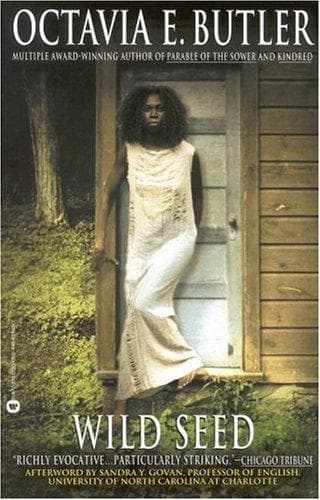
Book details and cover from Google Books.
Ready to read Wild seed?
Get your copy on Amazon, or listen to it on Audible. We earn a commission if you buy through these links.