
We earn a commission if you buy through these links. Learn more
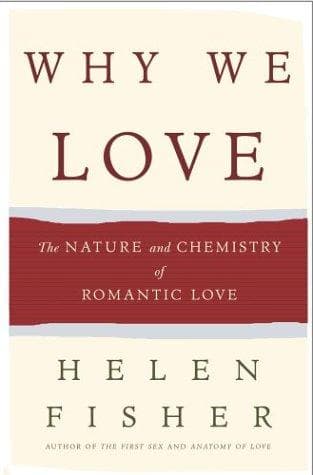
Why We Love
by Helen Fisher, Helen E. Fisher
Guide by the Books of the Day editors · Updated · How we write our guides
Helen Fisher treats romantic love as a distinct brain system with its own chemistry, a bold and accessible argument that rewrites how you think about falling in love.
What Creators Say About Why We Love
2 creators reviewed Why We Love on YouTube between 2007 and 2023, with 1.8M views between them. Their opinions are their own; we picked these reviews, we didn't write them.
What It's About
Helen Fisher, an anthropologist who has studied human mating for many years, argues that romantic love is not just a feeling that happens to us but a deep biological system with its own brain circuitry. She separates it from two related drives: the sex drive, and attachment, the calmer bonding that keeps partners together over years. Her main focus is romantic attraction, the craving and single-minded fixation that can lock your attention onto one particular person.
The approach blends cross-cultural anthropology, evidence from animal behavior, and a tour of brain chemistry, especially the dopamine-linked reward pathways and the hormones involved in bonding. The writing is accessible rather than technical. She explains neurotransmitters through everyday examples and uses biological vocabulary without assuming you have a science background.
Reading it feels like being walked through a case for love as something you can partly understand from the outside. Some readers find that reassuring, while others find it deflating. The book is less a memoir or self-help manual than an argument, with practical thoughts on attraction and relationships at the edges. Expect a mix of storytelling, research summary, and a steady push toward explanation.
Read this if you…
- are curious about the science behind attraction and why love feels so consuming
- want a clear framework for separating sexual desire, romantic longing, and long-term attachment
- enjoy popular science that connects brain chemistry to everyday experience
Skip it if you…
- want a relationship guide with step-by-step advice for finding or keeping a partner
- prefer literary or philosophical accounts of love that focus on meaning rather than mechanism
Key Ideas
- 1
Romantic love as a distinct brain system
Fisher proposes that lust, romantic attraction, and attachment are three separate systems, each with its own brain regions and chemistry. Seeing them apart helps explain why you can feel intense desire for one person while feeling calm bonding toward another, or why the two can drift in opposite directions over a relationship.
- 2
Love as a reward-driven craving
Early romantic passion, she argues, looks more like motivation and wanting than contentment. The dopamine-linked reward pathways that drive pursuit of food or goals are central, which accounts for the obsessive thinking, energy, and restlessness people often report when they first fall for someone.
- 3
Attachment as the long-term counterpart
Hormones such as oxytocin and vasopressin are linked to the steadier, quieter bond that tends to grow over years together. Fisher uses this to explain why intense early infatuation often gives way to companionship, and why the shift is biological rather than simply a failure of effort.
- 4
Pair-bonding as an evolved strategy
Fisher frames romantic love as an adaptation for choosing and committing to a partner, one that concentrates time and energy on a single person. Her evolutionary reasoning draws on comparisons with other species, which is a strong part of the book but also the part most open to debate.
- 5
Romantic love across cultures
Drawing on anthropological observation, Fisher argues that romantic love appears in a wide range of societies, not only in modern Western culture. This cross-cultural claim is one of the book's central supports for treating love as a human universal rooted in biology.
Limitations
Critics often argue that the book leans too heavily on neurochemistry, which can make complicated emotional and social experiences sound more fixed and mechanical than they are. The evolutionary explanations rest partly on speculation and comparisons with animals, which can be hard to test. Much of the neuroscience reflects research from the early 2000s, so some specifics have since been refined. The book also gives limited attention to same-sex relationships, cultural variation in how love is expressed, and the role of social context and personal history.
Questions Readers Ask
- Is Why We Love still relevant today?
- Its core framework, separating desire, romantic attraction, and attachment, remains widely discussed and useful. Some of the neuroscience reflects research from the early 2000s, so treat the specific chemical claims as a starting point rather than settled fact, and check newer work if you want the latest detail.
- Does Why We Love offer practical relationship advice?
- Only in limited form. Fisher's main aim is explanation, not guidance. A few passages touch on attraction and partner choice, but readers looking for concrete steps for dating or sustaining a relationship will likely want a dedicated self-help book alongside it.
- How does it compare with Helen Fisher's other work?
- Why We Love is more accessible and focused on romantic love than her earlier, more academic writing on human mating. If you want a broader view of how the brain shapes partner choice, her later books extend these ideas, but this one is the best entry point.
- Published
- 2004
- ISBN
- 9780805069136
- Difficulty
- intermediate
- Category
- Psychology
Book details and cover from Google Books.
Ready to read Why We Love?
Get your copy on Amazon, or listen to it on Audible. We earn a commission if you buy through these links.