
We earn a commission if you buy through these links. Learn more
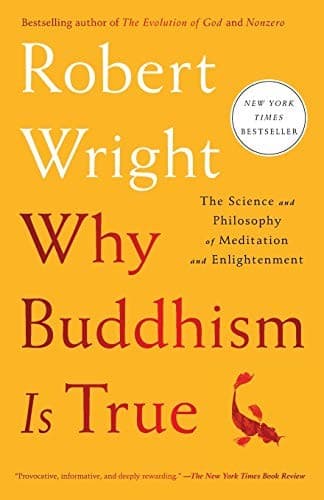
Why Buddhism is True
Robert Wright tests core Buddhist ideas about craving, suffering, and the self against evolutionary psychology and cognitive science, mixing argument with a meditator's personal experience.
What It's About
Why Buddhism Is True is nonfiction, despite the Fiction category listed for this page. Robert Wright, a journalist known for writing about evolution, psychology, and religion, is also a long-time meditator. The book asks whether the central teachings of Buddhism, especially those about craving, suffering, and the self, hold up when examined with modern science, or whether they are simply inherited tradition.
Wright's approach is part argument, part explainer, and part account of his own practice. He draws on evolutionary psychology to explain why minds get caught in loops of wanting and why a stable sense of self feels so convincing. He writes conversationally, with asides and digressions, which keeps the material accessible without turning it into a technical text. His main claim is that meditation works by helping you see these mental habits more clearly, and that this clarity is where the practical value lies.
Reading it feels like a long conversation with a sharp, somewhat skeptical friend who is persuaded but not uncritical. Expect some repetition and a pace that wanders at times. You will also be asked to accept some claims on partial evidence. The book is strongest when it stays with ideas and practice, and it is less convincing when it tries to settle every doctrinal question.
Read this if you…
- are curious whether Buddhist psychology has anything to say that modern science supports
- already meditate and want a thoughtful account of why the practice might work
- enjoy big-picture nonfiction that connects evolution, the mind, and ethics
Skip it if you…
- want a practical, step-by-step guide to meditation technique
- are looking for a neutral historical account of Buddhism or its many traditions
Key Ideas
- 1
Craving as the engine of suffering
Wright treats the Buddhist idea that dissatisfaction comes from craving as a testable claim rather than a slogan. He looks at how wanting and aversion drive behavior, and why getting what we want often fails to satisfy us for long. The argument is that understanding this pattern is more useful than trying to eliminate desire outright.
- 2
The self as a constructed story
A major thread is the Buddhist teaching that there is no fixed, independent self. Wright connects this with research on how the brain builds a narrative sense of identity from many separate processes. The point is not that you do not exist, but that the feeling of a unified, always-the-same self is a more fragile construction than it seems.
- 3
Meditation as seeing mental habits clearly
Wright presents meditation as a way of observing thoughts, feelings, and impulses as they arise, rather than as a tool for relaxation alone. He explains how this observation can loosen the automatic reactions that keep people stuck. His own experience with practice gives this section a grounded, personal tone.
- 4
Testing doctrine against evidence
The book repeatedly asks which Buddhist claims survive contact with modern knowledge and which do not. Wright is willing to set aside claims he finds less defensible and to say where the evidence is thin. This makes the book useful for skeptical readers, though some may wish he had gone further in certain places.
Limitations
Critics often note that Wright is an advocate, not a neutral scholar, and that he sometimes presents contested scientific findings with more confidence than they deserve. The book focuses mainly on one strand of Buddhist thought and practice, leaving out much of the history, ritual, and diversity of the wider tradition. Its discussion of concepts such as rebirth is limited. Some readers will also find the repetition and wandering structure tiring over a full length.
Questions Readers Ask
- Is Why Buddhism Is True a novel or nonfiction?
- It is nonfiction, even though this page lists it under Fiction. Robert Wright argues for the value of Buddhist ideas using psychology, evolutionary theory, and his own experience of meditation. There are no characters or plot. If you were looking for a novel with this title, it is not the same book.
- Do I need to be a Buddhist or a meditator to get something from it?
- No, but it helps. Readers without any meditation background can follow the arguments about craving and the self. Readers who already practice tend to get more from the personal sections and from the way Wright ties their experience to scientific ideas. Skeptics will find plenty to question, which is part of the book's value.
- Published
- 2017
- ISBN
- 9781439195468
- Difficulty
- intermediate
- Category
- Fiction
Book details and cover from Google Books.
Ready to read Why Buddhism is True?
Get your copy on Amazon, or listen to it on Audible. We earn a commission if you buy through these links.