
We earn a commission if you buy through these links. Learn more
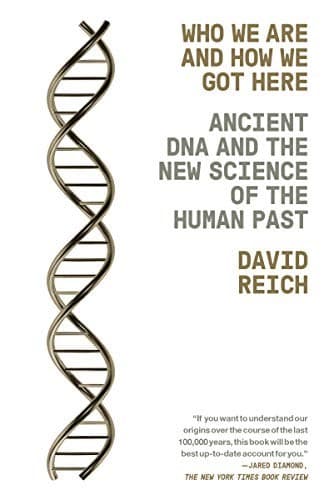
Who we are and how we got here
by David Reich
A geneticist's firsthand account of how ancient DNA is rewriting the story of human migration and mixing, and why that science is so easily misused in debates about race.
What It's About
Who We Are and How We Got Here is nonfiction, even though this listing is tagged as fiction. David Reich, a Harvard geneticist who works on ancient DNA, uses the recent flood of genomes recovered from old bones and teeth to trace how human populations moved, mixed, and split over tens of thousands of years.
Reich writes as a working scientist explaining how his field got its data and what that data can and cannot support. Much of the book is about method: how samples are recovered, how genomes are compared, and how researchers infer ancestry from patterns of shared DNA. The tone is direct and sometimes combative, since he spends real space on how genetics gets misused in arguments about race and on the public reaction to his own writing on the subject.
Reading it feels more like sitting in on a research group's arguments than taking a tidy survey. Expect technical stretches alongside vivid reconstructions of ancient migrations. You come away with a clearer sense of where scientists can speak with confidence about broad events and where they must hedge about details.
Read this if you…
- are curious how scientists actually know what they know about ancient human migrations
- want a researcher's perspective on the race debate and how genetics is misused in it
- are comfortable following some technical reasoning about DNA and population models
Skip it if you…
- want a story-driven history of humanity with little scientific detail, since the method discussion is substantial
- are looking for a neutral survey of the race debate rather than one shaped by the author's own positions
Key Ideas
- 1
Ancient DNA has transformed the field
Being able to read genomes from people who lived thousands of years ago has shifted questions that were once answered by guesswork, archaeology, or linguistics into testable claims. Reich argues that this change is as significant as any single discovery, because it lets researchers watch population events unfold rather than infer them from later traces.
- 2
Human populations have rarely stayed isolated
A recurring theme is that groups which seem distinct today are usually the product of earlier mixing between populations that had already diverged. The book shows how migrations and admixture reshaped regions such as Europe and South Asia, which undercuts the picture of pure, unchanging peoples that older narratives often assumed.
- 3
Genetic variation is real but easy to overread
Reich contends that the genetic differences between human groups are real and can be measured, yet that such patterns do not justify the crude racial categories many people assume. He pushes back on both those who deny that group differences exist and those who draw sweeping conclusions from thin evidence.
- 4
Reconstructions are models, not certainties
Much of what gets reported as settled history depends on statistical models and sparse samples, which can produce confident-sounding stories that later shift. The book is useful for seeing how that uncertainty is handled, and for learning to ask what evidence a given claim actually rests on.
Limitations
Critics have argued that Reich gives genetics a larger explanatory role than it deserves, and that social, political, and cultural forces get less weight than they need in explaining who mixed with whom and why. Some readers find his treatment of race contentious, and others feel he does not go far enough in addressing historical harms. The book also reflects the field as it stood in 2018, and the number of available ancient genomes has grown considerably since, so specific figures and conclusions may have moved.
Questions Readers Ask
- Is Who We Are and How We Got Here still relevant?
- Yes, mostly. The central idea that ancient DNA lets researchers reconstruct past population events is now well established, and the book's framing still holds up. Because the field has grown quickly since 2018, however, specific findings and sample counts have been updated, so treat the details as a snapshot and read newer reviews for the latest picture.
- How does it compare to Svante Pääbo's Neanderthal Man?
- Pääbo's book is more personal, following his own path into ancient DNA and the story of Neanderthal genomes. Reich's book is broader and more concerned with what population genetics reveals about human history as a whole, and it engages more directly with the race debate. Read Pääbo for the narrative of discovery and Reich for the wider argument.
- Do I need a science background to read it?
- No, but it helps to be comfortable with numbers and abstract reasoning. Reich explains his terms as he goes, and the big-picture argument is accessible to general readers. The methodological sections are where a non-scientist may need to slow down and reread.
- Published
- 2018
- ISBN
- 9781101873465
- Difficulty
- intermediate
- Category
- Fiction
Book details and cover from Google Books.
Ready to read Who we are and how we got here?
Get your copy on Amazon, or listen to it on Audible. We earn a commission if you buy through these links.