
We earn a commission if you buy through these links. Learn more
Who sank the boat?
by Pamela Allen
A tiny, rhythmic picture book whose repeated lines and sly illustrations let very young children predict the joke and join in.
What It's About
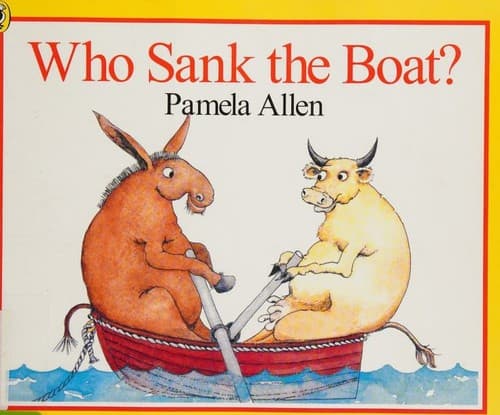
Who Sank the Boat? is a short picture book for very young children, written and illustrated by Pamela Allen, an Australian author known for her work for preschoolers. Its premise is simple: a small group of farm animals climbs into a little rowing boat, and something goes wrong. The story is built on repetition and rhyme, so the same few lines return as each animal arrives, which gives small listeners a pattern they can anticipate and join in with.
The pleasure is mostly in the pictures and the timing. Allen's illustrations carry much of the humor, with expressions and small physical details that let a child work out what is happening before the words say it. Reading it aloud is the point: a pause before the question, a chance for the child to guess, and a laugh at the end. It is not a book with a moral or a lesson beyond a bit of cheerful cause and effect.
Expect a short, light read rather than a story with depth. Adults will likely read it many times, and the rhythm does more work than the plot. It suits lap reading, bedtime, and early attempts at prediction and counting, and it asks almost nothing of the reader beyond patience and a willingness to be silly.
Read this if you…
- want a first book to read aloud to toddlers or preschoolers
- are helping a young child learn to predict words from rhythm and pictures
- enjoy simple, physical animal humor and want something short
Skip it if you…
- want a story with a developed plot, character growth, or a surprising narrative arc
- are looking for a book for older children or a more challenging read
Key Ideas
- 1
Repetition as a first reading tool
The refrain and rhyming structure repeat in a steady beat. Children learn to predict the next line, which builds confidence and memory. For a pre-reader, the pattern is the lesson: once you hear how the words move, you can start to join in. That makes the book useful well beyond its plot, especially for families working on early language and listening skills.
- 2
Pictures that tell the story first
Allen's artwork often reveals what is happening a moment before the text does. Children who look closely get the joke early and feel clever for spotting it. This rewards slow looking and gives adults a natural reason to pause, point, and ask what a child sees. The words and images work as a pair, and the gap between them is where the humor sits.
- 3
Cause and effect through simple comedy
The book runs on intuitive physics: more weight in a small boat means trouble. It teaches cause and effect without explaining it, through slapstick that young children find funny. There is no lecture about balance or safety. The reader simply watches what happens when one more creature climbs aboard, and the outcome is the entertainment.
- 4
Built for interaction rather than a message
This is a book to perform, not to absorb silently. Its question invites guessing and its structure invites counting and turn-taking. Parents and teachers can stretch it into a longer session by asking who is in the boat now, or what might happen next. Its value depends on how it is read, which is part of why it works in group settings too.
Limitations
The plot is minimal and the animals are not characters in any deep sense, so adults may tire of the joke after several readings. Its illustration style and farm setting reflect the early 1980s, and some readers may find it plain next to newer picture books that offer more diverse settings and richer art. It does not teach much beyond cause and effect and the pleasure of repetition, so it works best as a fun shared moment rather than a lesson.
Questions Readers Ask
- Who is Who Sank the Boat? best for?
- It is best for toddlers and preschoolers, roughly ages two to five, and for parents or teachers reading aloud. Very young children enjoy the repetition and the physical humor, and older preschoolers can take part by guessing what comes next. It is less satisfying for independent readers who want a longer story.
- How does it compare to other cumulative picture books?
- It shares the rhythm and predictability of classic cumulative books such as Audrey Wood's The Napping House, but it is lighter and quicker. Where those books build a calm, sleepy atmosphere, this one aims for a small burst of comedy. Readers who like that build-and-repeat structure will find it familiar, though less cozy.
- Published
- 1986
- ISBN
- 9780140566932
- Difficulty
- beginner
- Category
- Children's Books
Book details and cover from Google Books.
Ready to read Who sank the boat??
Get your copy on Amazon, or listen to it on Audible. We earn a commission if you buy through these links.