
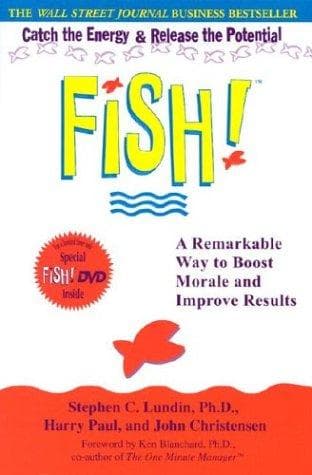
Fish
Stephen C. Lundin
Like Who Moved My Cheese?, it teaches a workplace lesson through a short story, here about choosing attitude and engagement, which suits readers who liked the parable format.
Reader-supported: when you buy through links on our site, we may earn an affiliate commission. Learn more
We earn a commission if you buy through these links. Learn more
Find Similar BooksA very short parable about four characters in a maze, useful mainly as a quick, shared vocabulary for talking about how people respond to change at work and in life.
Who Moved My Cheese? is a fable, not a manual. Its whole plot fits in the time it takes to read a long magazine article: two small humans and two mice live in a maze, and each day they go looking for cheese at a place they have visited before. One day the cheese is gone. The story follows how each character handles that moment, and the lesson comes from the contrast between their reactions rather than from an argument the author lays out.
The writing is deliberately plain, with simple sentences, a lot of white space, and cartoon-style drawings. Most readers finish in under an hour. The story does the work, and the book closes by stating its lessons outright, which will suit readers who like a clear takeaway and frustrate those who prefer to draw their own conclusions.
The experience is quick and a little uncomfortable in a useful way. You will likely recognize yourself in one of the characters, and perhaps in a couple of them. It works best as a conversation starter for a team, or as a reflective read before a difficult transition, rather than as a source of detailed strategy.
The book's starting premise is that the cheese moves regardless of anyone's preferences or expectations. Instead of asking how to prevent change, it asks how to respond once it has already happened, which shifts attention from the cause of the disruption to the reader's own next move.
The contrast between the characters suggests that outcomes depend heavily on attitude and early action. Two people face the same loss, but one stays fixed on how things used to be while the other adjusts. The point is simple, though it asks readers to notice where they have some agency.
One character keeps expecting the old supply to reappear and grows angry when it does not. The book uses this pattern to show how denial and resentment can cost far more time than the change itself, and how staying put can feel safe while quietly making a situation worse.
The more adaptable character admits the fear, starts moving before the situation feels comfortable, and treats the new territory as something to explore. The idea is that acknowledging change early and acting in small ways makes the eventual adjustment far less painful than waiting for certainty.
Critics have long argued that the book is thin and treats change as something people should simply accept, without asking who decides to move the cheese or why. It says little about power, pay, layoffs, or fair treatment, leaving readers to fill those gaps themselves. Its tidy contrast between the sensible and the stubborn can feel patronizing to people facing real loss. Published in 1998, its corporate setting feels dated, though the core metaphor still travels well.
Reviews from readers on YouTube. Their opinions are their own.
Book details and cover from Google Books.
Ready to read Who Moved My Cheese??
Get your copy on Amazon, or listen to it on Audible. We earn a commission if you buy through these links.
Stephen C. Lundin
Like Who Moved My Cheese?, it teaches a workplace lesson through a short story, here about choosing attitude and engagement, which suits readers who liked the parable format.
John Kotter, Holger Rathgeber
A fable about a penguin colony that must respond to a melting home. Its simple story and clear change message will appeal to readers who enjoyed the cheese parable.
Paulo Coelho
A fable about a shepherd who learns to follow signs and move forward when life shifts. Readers drawn to the quiet wisdom of Who Moved My Cheese? will find a similar spirit here.
Carol S. Dweck
Dweck's research on fixed and growth mindsets builds on the source book's idea that attitude shapes how we handle change, giving readers a deeper explanation of why it matters.