
We earn a commission if you buy through these links. Learn more
We Were the Lucky Ones
Guide by the Books of the Day editors · Updated · How we write our guides
A family saga drawn from the author's own history, following scattered Polish Jewish relatives through the Second World War with patience and emotional honesty.
What Creators Say About We Were the Lucky Ones
2 creators reviewed We Were the Lucky Ones on YouTube between 2018 and 2024, with 202.7K views between them. Their opinions are their own; we picked these reviews, we didn't write them.
What It's About
We Were the Lucky Ones follows the Kurc family, a large Jewish family from Radom, Poland, as the Second World War tears them apart. Georgia Hunter's novel is based on her own family's history, and she spreads the story across several siblings and relatives, moving between occupied Poland, Soviet territory, and the United States. The narrative shifts between perspectives and years, so the reader holds the pieces together while the family often does not know where each other are.
Hunter's prose is clear and direct rather than lyrical. She leans on everyday detail: meals, letters, small negotiations for papers and money, and the strained decisions about who leaves and who stays. The effect is less a single plot than a patchwork of separate survivals, and the book trusts readers to feel the distance between family members as much as the danger they face.
Reading it is an emotional and sometimes exhausting experience. It is long, and the structure asks for patience, since you spend stretches of the book apart from characters you have come to care about. It suits readers who want a character-driven account of the war's upheaval rather than a tightly plotted thriller.
Read this if you…
- want a character-driven novel about the Second World War rather than a fast-moving thriller
- enjoy multigenerational family sagas and don't mind a large cast
- want a personal, research-based look at Jewish family life in Poland before and during the war
Skip it if you…
- need a tightly plotted story built around one central protagonist
- are looking for lyrical, highly crafted prose or a broad history of the Holocaust
Key Ideas
- 1
Family as the thread of survival
The book keeps returning to who stays together and who gets separated, treating family loyalty as both a source of strength and a painful burden. Decisions about who leaves, who waits, and who sends money or documents carry real stakes, and Hunter shows how love can push people toward choices that split them apart.
- 2
Luck as a shaping force
The title points to the arbitrary nature of survival. Some relatives escape through timing or a lucky break, while others with similar courage do not. Hunter does not present luck as a reward for virtue; she asks readers to sit with how much of an outcome rests on chance, and what survivors carry afterward.
- 3
Historical grounding in a real family
Because the novel draws on the author's relatives, it reads as a reconstruction of lived history rather than a detached survey. Hunter's research into family memory and records shapes the settings and daily details, giving the story a documentary texture, though the scenes and inner lives are imagined and shaped for narrative.
- 4
Dispersal across continents and years
The narrative moves between Poland, the Soviet Union, and the United States across several years. This spreading out is the book's central structural choice: it makes the reader experience separation as the family does, with partial news, long silences, and uncertainty about who is still alive.
Limitations
Some readers find the prose plain and the sentiment heavy, and the sprawling cast and frequent jumps in time can feel scattered, especially early on. Because it is a family saga, it covers one family's journey rather than the wider history of the Holocaust. As a novel built on real relatives, it also takes imaginative liberties that historically minded readers may question. Its emotional beats are familiar to anyone who has read much wartime fiction.
Questions Readers Ask
- Is We Were the Lucky Ones based on a true story?
- Yes, it is inspired by the author's own family history. Georgia Hunter built the novel around her relatives, the Kurc family, and drew on family memory and research into their wartime experiences. Real events anchor the book, but many scenes and inner lives are imagined to make the story work as fiction.
- How does it compare to All the Light We Cannot See?
- Both are historical novels about the Second World War with split perspectives. All the Light is more lyrical and tightly structured, built around two young characters. We Were the Lucky Ones is looser and more sprawling, focusing on a whole family scattered across several countries and years.
- Published
- 2017
- ISBN
- 9780749021986
- Difficulty
- intermediate
- Category
- Fiction
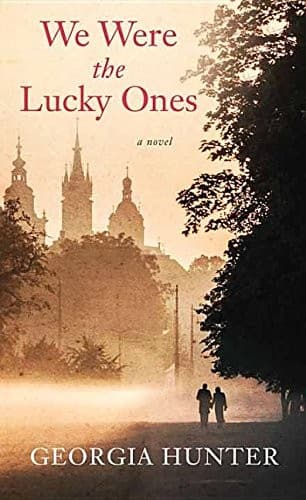
Book details and cover from Google Books.
Ready to read We Were the Lucky Ones?
Get your copy on Amazon, or listen to it on Audible. We earn a commission if you buy through these links.