
We earn a commission if you buy through these links. Learn more
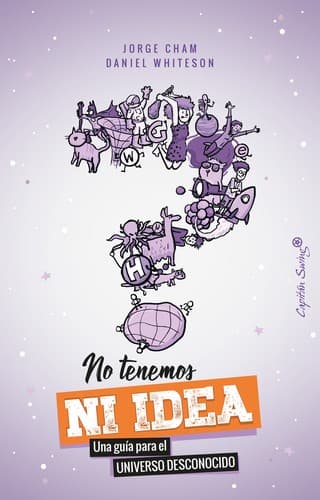
We Have No Idea
by Jorge Cham, Daniel Whiteson
Guide by the Books of the Day editors · Updated · How we write our guides
Cham and Whiteson turn physics's unanswered questions into a funny, approachable tour of what we don't know, and why not knowing is the exciting part.
What Creators Say About We Have No Idea
2 creators reviewed We Have No Idea on YouTube between 2017 and 2021, with 28.3K views between them. Their opinions are their own; we picked these reviews, we didn't write them.
What It's About
We Have No Idea is a popular science guide written by Daniel Whiteson, a particle physicist who works on experiments at CERN, and Jorge Cham, the cartoonist behind PhD Comics. Rather than presenting physics as a finished catalogue of answers, it focuses on the places where current theory runs out: the unseen mass that seems to hold galaxies together, the energy apparently driving cosmic expansion, the imbalance between matter and antimatter, and the puzzles of quantum measurement.
The approach mixes conversational prose with Cham's cartoons, so the book reads quickly and the jokes do real explanatory work. Whiteson's voice comes through in stories from years of working on large collider experiments, which show how physicists decide what counts as a discovery and how much of the job is ruling possibilities out.
The experience is less like a textbook and more like sitting with two enthusiastic experts who keep pointing at the blank spots on the map. Readers who expect a tidy story of steady progress will find something more honest: a frontier that is wide, uncomfortable, and full of ideas that may turn out to be wrong. Many topics get only a few pages, so the reader comes away with orientation rather than mastery.
Read this if you…
- are curious about physics but never got past a high school textbook
- want an honest picture of how science works at the frontier
- enjoy humor paired with serious ideas and don't mind comics in a science book
Skip it if you…
- want a clear, step-by-step introduction to physics with equations and worked examples
- need a thorough survey of current theories, since this book skims many topics quickly
Key Ideas
- 1
Ignorance as a working tool
The book treats gaps in knowledge as leads rather than embarrassments. A measurement that disagrees with theory tells scientists exactly where to dig, which is why the authors present unanswered questions as the engine of research rather than a failure of it.
- 2
Most of the universe remains mysterious
Current measurements suggest that the ordinary matter we understand, the stuff of stars, planets and people, is only a small part of what the cosmos contains. The rest, usually labeled dark matter and dark energy, is known mostly by its effects, and the book explains why that is so unsettling.
- 3
What failed experiments still teach
A search that finds nothing is not wasted. The authors show how null results narrow the field of possible theories, and how the long stretches of ruling things out that make up much of experimental work can be frustrating, slow, and yet essential to progress.
- 4
Where our best theories break down
Physics has two extremely successful frameworks that do not fit together neatly, along with unresolved puzzles about quantum measurement. The book uses these tensions to ask whether science can eventually explain everything, or whether some questions may always stay open.
Limitations
The book prioritizes breadth over depth, so most subjects receive a few pages and readers wanting detail will need follow-up reading. Some readers find the jokes and the chatty tone repetitive over a full book. Experimental results in fast-moving fields change, so specific findings may be out of date even though the big open questions remain. It also stays within physics and cosmology, offering little on biology, medicine, or the social sciences.
Questions Readers Ask
- Do I need a physics background to read it?
- No. The book is written for general adult readers and keeps the mathematics out of the way. Some ideas, especially in quantum mechanics, are hard to grasp however they are explained, so a bit of patience helps. The cartoons often make abstract points easier to hold onto.
- Is We Have No Idea still relevant?
- The core questions it covers, such as the nature of dark matter, dark energy, and the matter-antimatter imbalance, remain open, so its framing holds up well. Specific experimental results and proposed explanations may have moved on since publication, so treat the details as a snapshot and the big picture as the lasting value.
- Published
- 2017
- ISBN
- 9781472239266
- Difficulty
- beginner
- Category
- Popular works
Book details and cover from Google Books.
Ready to read We Have No Idea?
Get your copy on Amazon, or listen to it on Audible. We earn a commission if you buy through these links.