
We earn a commission if you buy through these links. Learn more
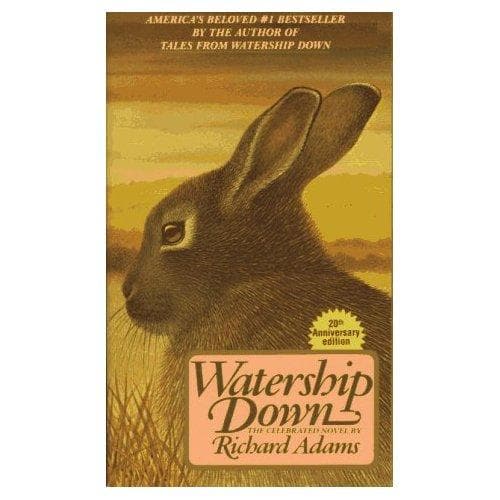
Watership Down
by Richard Adams, Richard Adams
Guide by the Books of the Day editors · Updated · How we write our guides
Richard Adams turns a simple story of rabbits searching for a new home into a serious study of fear, leadership, and belonging, told with unusual nerve.
What Creators Say About Watership Down
2 creators reviewed Watership Down on YouTube between 2021 and 2025, with 10.5K views between them. Their opinions are their own; we picked these reviews, we didn't write them.
What It's About
Watership Down (1972) follows a group of wild rabbits who leave their home warren after one of them, a young buck named Fiver, senses that something terrible is coming. Their journey takes them across the English countryside in search of a place to settle, and it becomes a test of whether a small, frightened community can learn to trust and organize itself. Adams built the book on close attention to how rabbits actually behave: their dependence on warning signals, their scent-marking, and their instinct to burrow and flee.
The approach is what sets it apart from a typical animal adventure. Adams gives the rabbits their own language, Lapine, and a body of folklore centred on a trickster hero, El-ahrairah, whose stories shape how the rabbits understand their world and themselves. The narration stays close to the animals' perception, so the landscape feels vast and dangerous, full of things they cannot name, such as roads, dogs, farms, and other creatures whose motives they can only guess at. Violence appears plainly and is not softened.
Reading it feels less like a fast-moving thriller and more like being absorbed into a long, unhurried myth. The early stretch is slow and anxious, and the middle builds a sense of community through debate, disagreement, and small acts of courage. Some readers find the pace uneven, but many describe the book as one that stays with them, partly because it treats fear and leadership with unusual seriousness.
Read this if you…
- want a long, immersive story in which animals are serious characters rather than cute mascots
- enjoy stories about how groups make decisions under threat
- like myths, folk tales, and invented languages
Skip it if you…
- need fast plot momentum or a light, cheerful tone from the first chapters
- are put off by graphic violence, since animal deaths are shown directly
Key Ideas
- 1
Fear as a force that shapes decisions
Fiver's warnings set the whole story in motion, and the rabbits constantly weigh caution against action. Adams shows how fear can paralyse a group, sharpen its judgment, or push it toward reckless choices. The book is less interested in heroic bravery than in the everyday work of acting while frightened.
- 2
Two models of leadership, compared
The story sets quiet, earned authority against rule by intimidation, through the contrast between the group's chosen leader and the tyrannical ruler of a rival warren. Adams asks what makes followers willing to follow, and what happens when a community is run by threat. Readers who enjoy political fiction will find this thread especially rich.
- 3
Folklore as a way of seeing the world
The rabbits' stories about El-ahrairah are more than decoration. They give the characters a shared identity, moral vocabulary, and comfort, and they show how a culture makes sense of danger. Adams treats this mythmaking as seriously as the travel plot itself.
- 4
Close observation of ordinary animal life
Much of the book's texture comes from its attention to real rabbit habits, including how they read the land, signal alarm, and organise their burrows. This grounding makes the animals feel like animals rather than people in costumes. It also gives the book a naturalist's eye that many readers find unexpectedly absorbing.
Limitations
The opening is slow, and the long stretches of travel and rabbit small talk can feel repetitive to readers expecting a tighter plot. The rabbit-centred viewpoint is a deliberate choice, but it can make the animals' world feel closed off from anything beyond their immediate concerns. Critics have also pointed to the male-dominated cast, with female rabbits mostly in supporting roles, which reads as dated today. Some find the allegorical parallels to human politics heavy-handed. The book does not offer much beyond its own warren-based world.
Questions Readers Ask
- Is Watership Down a children's book?
- It is often read by children, and it was widely shared as a family book, but it is written for a general adult audience. The violence, the fear, and the treatment of death are direct, so it suits older children and adults better than younger readers. Parents may want to read it first.
- How does it compare to The Wind in the Willows?
- The Wind in the Willows is whimsical and cosy, with animals who live in human-like homes and enjoy human-like pleasures. Watership Down is wilder and darker, closer to the real behaviour of its animals, and its tone is more anxious and serious. Readers who like one may not always enjoy the other.
- Is it still worth reading today?
- Yes, for its portrait of fear, community, and leadership, which has not dated. Its gender representation is more open to criticism now, so readers should expect that. Many people still find it one of the most memorable novels about animals ever written.
- Published
- 1972
- ISBN
- 9788741838540
- Difficulty
- intermediate
- Category
- Fiction
Book details and cover from Google Books.
Ready to read Watership Down?
Get your copy on Amazon, or listen to it on Audible. We earn a commission if you buy through these links.