
We earn a commission if you buy through these links. Learn more
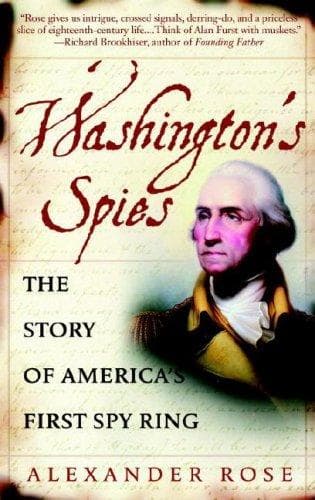
Washington's Spies
A narrative look at the small Long Island spy network that gave George Washington rare insight into British-occupied New York, told through the ordinary people who risked their lives to run it.
What It's About
Washington's Spies follows the Culper ring, a small network of Long Island agents that gave George Washington one of the more reliable windows into British-occupied New York City during the Revolutionary War. Alexander Rose builds the story around the people involved: Abraham Woodhull, a farmer who wrote under the name Samuel Culper; Robert Townsend, a merchant who reported from inside the city; Anna Strong, whose part in passing messages is easy to overlook; and Benjamin Tallmadge, the Connecticut officer who ran the operation from the American side.
The book is narrative history rather than a dry archival study. Rose describes the practical problems the ring faced: moving letters across enemy lines, hiding messages in everyday objects, and keeping identities secret from one another and from the people closest to them. Much of the pleasure comes from watching amateurs learn tradecraft under constant threat, where every courier trip could end in execution.
Reading it feels more like working through a tense case file than a textbook. Rose moves between the city, the countryside, and Washington's headquarters, so the war appears as an intelligence contest as well as a series of battles. Expect plenty of concrete logistics and vivid personalities, with a steady build toward the moments when the network's reports mattered most.
Read this if you…
- are curious about the Revolution beyond the battlefield
- enjoy character-driven narrative history with a suspenseful edge
- want a concrete picture of how espionage worked in the eighteenth century
Skip it if you…
- want a sweeping, balanced account of the whole war
- need a heavily footnoted scholarly argument about sources and method
Key Ideas
- 1
Intelligence as improvised craft
Before modern tradecraft existed, the Culper ring invented its methods as it went. Rose shows the trial and error behind invisible inks, ciphers, dead drops, and coded signals, and how much depended on improvisation and nerve rather than training or formal institutions.
- 2
Ordinary people as the network
The ring was made up of a farmer, a merchant, a courier-linked household, and a young officer, not professional spies. The book makes a strong case that the Revolution's intelligence successes came from neighbors, relatives, and local loyalties, which also made them fragile.
- 3
Secrecy as both shield and weakness
Compartmentalization protected the network, since agents often knew little about each other. But it also created gaps, delays, and misunderstandings. Rose returns repeatedly to the tension between keeping everyone safe and getting useful information to the commander in time.
- 4
The war as a contest of information
Rose argues that knowing what the British planned in New York shaped American decisions as much as the battles did. The book reframes the Revolution partly as a struggle over who knew what, and when, which gives familiar events a different texture.
Limitations
Because the surviving letters and records are limited, Rose has to infer some of the agents' motives and feelings, and some scenes are reconstructed to give the story momentum. Some readers find the characterizations warmer than the evidence strictly allows. The book also covers only one network, so it says less about the wider intelligence picture or about how much the ring changed the outcome of the war.
Questions Readers Ask
- Is Washington's Spies a good first book on the American Revolution?
- Yes, if you want an accessible entry point. It is focused on one network and its personalities rather than the full sweep of the war, which makes it easy to follow. Readers who want the broader political and military context may want to pair it with a general survey afterward.
- How does it differ from a biography of George Washington?
- Washington appears mainly as the recipient of the ring's reports, not as the book's central figure. The focus is on the agents on Long Island and in New York City, and on the logistics of gathering and delivering information. If you want Washington's own life and decisions, a full biography will serve you better.
- Does the book still hold up as history?
- The core story is well grounded in the surviving correspondence, and the tradecraft details remain interesting. Some interpretive choices and dramatized moments are more storytelling than documentation, so it is best read as a compelling narrative with a historian's care rather than as the final word on the ring.
- Published
- 2006
- ISBN
- 9780553804218
- Difficulty
- beginner
- Category
- History
Book details and cover from Google Books.
Ready to read Washington's Spies?
Get your copy on Amazon, or listen to it on Audible. We earn a commission if you buy through these links.