
We earn a commission if you buy through these links. Learn more
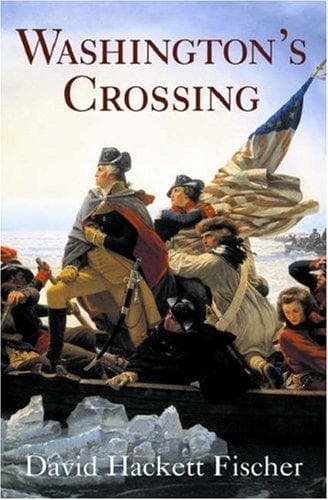
Washington's crossing
Guide by the Books of the Day editors · Updated · How we write our guides
Fischer turns a short, bitter winter campaign into a granular study of soldiers, supply, and weather, showing how a few December days in 1776 shaped the war.
What Creators Say About Washington's crossing
2 creators reviewed Washington's crossing on YouTube between 2024 and 2026, with 7.6K views between them. Their opinions are their own; we picked these reviews, we didn't write them.
What It's About
Washington's Crossing covers the period from the autumn 1776 retreat across New Jersey to the victories at Trenton and Princeton in late December and early January. Fischer, a historian of early America, does not treat it as a single heroic dash across a river. He reconstructs the campaign day by day from a wide range of sources, including letters, diaries, orders, and recollections from American, British, and German participants, as well as civilians who lived through the march.
The result is dense and deliberately textured. Fischer stops often to test accounts against one another, correct familiar legends, and explain why a route or an order made sense to the people who chose it. Weather, roads, river ice, footwear, and the state of militia enlistments receive as much attention as the generals' decisions. Readers who want a clean story of Washington as a commanding figure will find it more complicated, since the book keeps asking what people knew at the time and what they could actually do.
Reading it feels less like following a novel than sitting in on a careful seminar where the evidence is laid out in full. The pace slows at moments a popular account would skip, and the payoff is a sharper sense of how fragile the Continental Army was. Expect a long book that rewards patience, with extensive notes that many readers use as a guide to further reading.
Read this if you…
- want a detailed military history of one pivotal winter campaign
- are interested in how logistics and weather shape decisions in war
- enjoy seeing famous episodes re-examined closely against the sources
Skip it if you…
- want a short, fast narrative or a character-driven biography of Washington
- find long stretches of tactical and logistical detail tiresome
Key Ideas
- 1
The campaign as a race against expiring enlistments
Fischer keeps returning to the calendar. Many soldiers' terms of service were ending at the close of 1776, and the American army was shrinking as the weather worsened. That pressure helps explain why Washington felt he had to act when he did, and why a small, risky success could matter so much.
- 2
Weather, logistics, and the ordinary soldier
Rather than treating the crossing as a matter of nerve and genius, the book shows how cold, ice, exhaustion, poor clothing, and unreliable supply shaped what was possible. Ordinary soldiers appear as people making hard choices under bad conditions, not just as units moving on a map.
- 3
Why both sides misjudged each other
The book examines the thin and often wrong intelligence each commander relied on. British leaders assumed the rebellion was nearly broken and that winter would give them time, while the Americans had to guess at enemy dispositions. Fischer uses these gaps to explain why certain surprises worked.
- 4
Testing popular legends against documentary evidence
Fischer is a historian who argues openly with received stories. He weighs contemporary sources against later retellings and tells readers where the record is firm and where it is not. This habit makes the book useful for anyone who wants to learn how historians decide what happened.
Limitations
Critics sometimes find the book too long and too granular for its subject, with tactical and logistical detail slowing the narrative. Its focus is almost entirely military and centered on the New Jersey campaign, so readers looking for political background, the wider context of independence, or the experience of civilians beyond the battlefield will need other sources. Some of its interpretations of motive remain debatable, as is true of any work reconstructing decisions from limited records. Maps and more recent scholarship are worth consulting alongside it.
Questions Readers Ask
- Who is Washington's Crossing best suited to?
- It suits readers who already know the outline of the Revolutionary War and want depth. Those with a serious interest in military history, or in how historians weigh evidence, will likely get the most from it. Casual readers may find the level of detail demanding, but patience is usually rewarded.
- How does it compare to shorter popular accounts of the crossing?
- Popular narratives tend to move quickly through the Delaware crossing and the battles at Trenton and Princeton. Fischer slows down to examine why each step happened, what the participants knew, and which stories hold up. If you want the excitement of the event, a shorter book may serve you better. If you want to understand it, this one goes further.
- Published
- 2004
- ISBN
- 9781419304941
- Difficulty
- intermediate
- Category
- History
Book details and cover from Google Books.
Ready to read Washington's crossing?
Get your copy on Amazon, or listen to it on Audible. We earn a commission if you buy through these links.