
We earn a commission if you buy through these links. Learn more
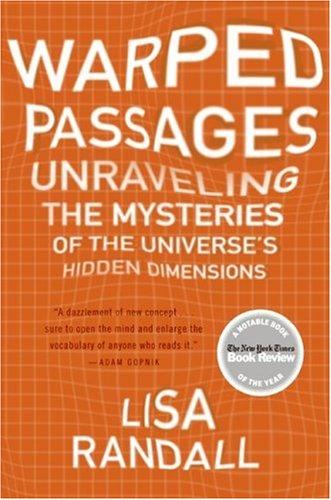
Warped Passages
by Lisa Randall
Guide by the Books of the Day editors · Updated · How we write our guides
Lisa Randall's Warped Passages makes the strange idea of hidden extra dimensions concrete, guiding readers through the hierarchy problem with unusual patience and clarity.
What Creators Say About Warped Passages
2 creators reviewed Warped Passages on YouTube in 2020, with 218 views between them. Their opinions are their own; we picked these reviews, we didn't write them.
What It's About
Warped Passages is Lisa Randall's 2005 attempt to explain a strand of theoretical physics that has become one of the more ambitious ideas in modern cosmology: that our universe may contain additional spatial dimensions hidden from everyday experience. Randall, a Harvard particle physicist who helped develop some of these models, takes the reader through the reasoning step by step rather than simply announcing conclusions.
The core problem driving the book is the hierarchy problem. Gravity is vastly weaker than the other fundamental forces, and no one has a fully satisfying explanation for why. Randall builds up an answer by showing how a curved, warped extra dimension could make gravity appear feeble in our part of space. Along the way she covers the Standard Model, the Large Hadron Collider, dark matter, and the history of how physicists arrived at these questions.
The experience is that of a patient, dense guided tour. Expect long stretches of careful explanation, analogies that she tests and refines, and occasional asides about her career and the physics community. It reads more like a seminar lecture written for curious adults than a popular summary, and the payoff is a much clearer sense of how working physicists reason about what they cannot yet observe.
Read this if you…
- want a serious, step-by-step introduction to extra dimensions
- already know basic physics and want a deeper conceptual tour
- are curious how working particle physicists reason about questions they cannot yet test
Skip it if you…
- want a light, purely narrative science book with little technical detail
- need up-to-date results from the Large Hadron Collider or recent discoveries
Key Ideas
- 1
The hierarchy problem: why gravity is so weak
Gravity is far weaker than the electromagnetic, weak, and strong forces, and the gap in strength is enormous. Physicists have long treated this mismatch as a puzzle that demands an explanation rather than a fact to accept. Randall makes it the central motivation for the whole book, showing why conventional answers have struggled and why that pushes researchers toward looking beyond three spatial dimensions.
- 2
Extra dimensions hidden from everyday experience
The book argues that additional spatial dimensions could exist without our noticing them, perhaps because matter and forces are confined to a lower-dimensional layer. Randall explains what it would mean for a dimension to be compact or hidden, and how such a setup changes the way forces spread. She is careful to separate what the mathematics allows from what has actually been observed, which is a useful habit for any reader.
- 3
Warped geometry as a possible explanation
The distinctive proposal is that the extra dimension might be curved or warped, so the strength of gravity depends on where you are within it. Randall walks through how this geometry can make gravity look feeble in our region while leaving the underlying theory intact. The idea is built up in layers, which is more useful than a single slogan.
- 4
How particle experiments could test these ideas
Much of the later material asks what these models would look like in experiments, especially at high-energy colliders. Randall discusses the kinds of particles and signals that could reveal extra dimensions, and the limits on what current experiments can rule in or out. It gives a grounded picture of how theory and data interact, even though the predicted signals have not been confirmed by experiment.
- 5
Dark matter as a neighboring puzzle
Randall places dark matter and the Standard Model in the same conversation, showing how physicists look for gaps in one theory by checking how it fits with others. Readers should expect this to be a supporting thread rather than the main subject. It helps explain why the extra-dimension ideas attracted so much attention in the first place.
Limitations
The book was written before the Large Hadron Collider began producing data, so its discussion of possible experimental signatures has since been partly tested without confirming the extra dimensions or the particles the models suggested. Some readers find the balance between physics and personal narrative uneven, and the sections on the Standard Model can feel slow without a basic background. Critics also argue that the warped-dimension models are speculative. Randall acknowledges this, but it can make parts of the book read more like advocacy than survey.
Questions Readers Ask
- Do I need a physics background to read Warped Passages?
- Some background helps. You do not need equations, but you should be comfortable with basic ideas like forces, particles, and energy. Randall explains her concepts carefully, so motivated general readers can follow most of it, though the middle sections can feel dense without prior exposure to the Standard Model.
- Is Warped Passages still relevant today?
- The core questions remain active in theoretical physics, and the book is still a strong conceptual introduction. However, it predates the Higgs discovery in 2012 and the subsequent LHC results, so its experimental discussion is dated. Pair it with newer sources if you want current status.
- How does it compare to Brian Greene's The Elegant Universe?
- Greene surveys string theory more broadly and aims for wide accessibility. Randall focuses more narrowly on one family of extra-dimension models and goes deeper into the reasoning behind them. If you want an overview of several ideas, start with Greene; if you want to follow one line of argument closely, Randall is the better choice.
- Published
- 2005
- ISBN
- 9780060531096
- Difficulty
- intermediate
- Category
- Science
Book details and cover from Google Books.
Ready to read Warped Passages?
Get your copy on Amazon, or listen to it on Audible. We earn a commission if you buy through these links.