
We earn a commission if you buy through these links. Learn more
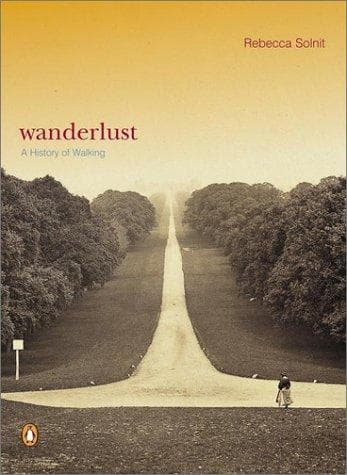
Wanderlust
Solnit's cultural history of walking ranges from ancient philosophers to suburban sprawl, showing how a simple act has shaped thought, cities, and ideas of freedom.
What It's About
Wanderlust is a cultural history of walking by Rebecca Solnit, written as a meditation on why people walk, what it has meant to them, and how the act has been shaped by religion, philosophy, politics, and the built world. It is not a how-to guide or a fitness book. Solnit moves between ancient schools of peripatetic thinkers, medieval pilgrims, Romantic writers who rambled through the countryside, and urban wanderers who turned the city street into a place of observation. Along the way she follows how roads, cars, and suburbs changed what walking could mean.
The style is essayistic and digressive, closer to a long conversation with a well-read companion than a textbook. Solnit weaves personal observation with historical material, so a passage about a famous writer's habits can drift into a reflection on the streets of her own neighborhood. Her sentences are rich and often lyrical, and she is more interested in patterns and associations than in building a single argument step by step. Readers who want tight chronology or a tightly sourced thesis may find the connections loose.
Reading it feels slow and unhurried, much like a good walk. It rewards readers who like to stop and turn an idea over, and it leaves you looking at a familiar street or country lane with a little more attention than before.
Read this if you…
- are curious about how walking has influenced philosophy, art, and writing
- enjoy essayistic books that wander between history, memoir, and observation
- want to look at everyday streets and landscapes with fresh attention
Skip it if you…
- want a practical guide to walking for fitness, health, or training
- need a tightly structured argument or a clear chronological history
Key Ideas
- 1
Walking as a way of thinking
Solnit argues that the rhythm of steps can loosen the mind and make room for thought. She draws on philosophers who taught while walking and writers who found their best ideas on foot, treating movement as a condition for reflection rather than a break from it.
- 2
The city street as a place to observe
The urban walker, often described through the figure of the flâneur, becomes a way of seeing crowds, buildings, and everyday life. Solnit examines how cities have been designed for or against pedestrians, and how the act of strolling has shaped urban culture and its sense of public space.
- 3
Cars, roads, and the decline of the pedestrian
As automobiles and suburbs spread, walking became harder, less practical, and in many places a sign of poverty or eccentricity. Solnit traces how the landscape itself was reorganized around driving, and what was lost when everyday movement on foot stopped being normal.
- 4
Pilgrimage and the purpose of going on foot
Long journeys made on foot for religious or personal reasons show that walking has often carried meaning beyond transport. Solnit uses these examples to suggest that the journey itself, with its discomfort and time, can be part of what a traveler seeks.
Limitations
The book's focus is largely Western, centered on European, British, and North American examples, so it does not offer a global history of walking. Its loose, digressive structure can make the throughline hard to follow, and some of its interpretations are personal and suggestive rather than firmly proven. Readers coming for facts about city planning or transport policy may find the coverage thin, and some observations about cars and suburbs reflect the period when it was written.
Questions Readers Ask
- Who is Wanderlust best suited for?
- It suits readers who enjoy reflective, literary nonfiction and are happy to follow an author's associations rather than a strict timeline. If you like books that mix cultural history with personal observation, you will likely find it rewarding. Readers wanting a concrete manual or a rigorous academic study should look elsewhere.
- Is Wanderlust still relevant today?
- Its central questions about walking, cities, and how cars reshaped everyday life remain relevant, especially for anyone thinking about urban design or sustainable travel. Some examples and observations reflect the period when it was written, so the ideas are often more durable than the specific details.
- Published
- 2000
- ISBN
- 9781783780396
- Difficulty
- intermediate
- Category
- History
Book details and cover from Google Books.
Ready to read Wanderlust?
Get your copy on Amazon, or listen to it on Audible. We earn a commission if you buy through these links.