
We earn a commission if you buy through these links. Learn more
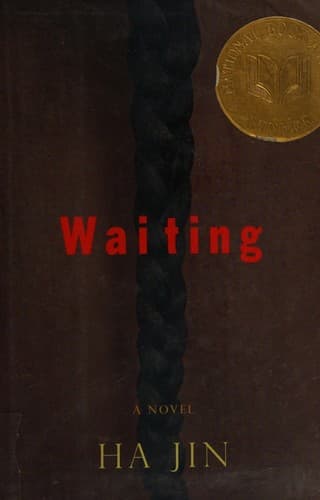
Waiting
Ha Jin's National Book Award winner turns a doctor's decades-long wait for a divorce into a quiet, unsparing study of how institutions shape private life.
What It's About
Waiting is a novel about a marriage arranged long before its two people were ready for each other, and about the bureaucracy that governs personal life in China across the Mao and post-Mao years. Lin Kong, an army doctor, is bound to a rural match he never wanted, and his attempts to end it run through an institution that moves slowly and follows its own logic. The story spans many years, so the reader watches one unresolved question shape an entire life.
Ha Jin writes in a flat, deliberately plain English, with short declarative sentences, little metaphor, and almost no ornament. Readers expecting lyrical description may find it stark at first, but the restraint is the point. Feeling is carried by what characters do, what they decline to say, and small domestic details that accumulate. The narration keeps a steady distance from its people, so judgment is left largely to the reader.
Reading it is slow and quietly absorbing rather than gripping in the usual sense. Its chapters build a pattern of repetition, delay, and compromise that mirrors the title. It rewards patience and close attention, and its emotional weight arrives gradually, through accumulation rather than dramatic set pieces.
Read this if you…
- want a serious, quiet novel about how public systems shape private lives
- are interested in Chinese society during the Mao and post-Mao decades
- can enjoy spare prose and a slow build without needing big plot turns
Skip it if you…
- need fast pacing or a plot that keeps producing surprises
- want lush description, vivid imagery, or lyrical sentences
Key Ideas
- 1
Institutions that control private desire
The army and its approval procedures decide what counts as a legitimate life. Love and marriage become matters of paperwork, permission, and waiting for a stamp. The novel shows how an organization can hold a person's most intimate choices hostage without ever openly forbidding them.
- 2
Duty, loyalty, and the cost of staying
Lin Kong's sense of obligation to his wife, his career, and his own sense of decency pulls him in several directions. Many of his choices come from genuine conscience, yet they harden into a life he did not quite choose. The book asks what we owe to commitments we did not make freely.
- 3
Restraint as a storytelling method
Ha Jin keeps his sentences plain and his emotions mostly under the surface. Nothing is overstated, so the reader has to work out what people feel from their silences and small actions. This method is the book's signature and the main reason it feels so precise.
- 4
Time as the central pressure
Years pass across the telling, and waiting reshapes everyone it touches. People age, adjust, and settle for less than they hoped for. The novel makes the slow erosion of hope feel as consequential as any dramatic event.
Limitations
Some readers find the flat prose monotonous, and the deliberate stiffness of the English can feel distancing over a long book. The characters can seem passive, and their repeated indecision may frustrate readers who want them to act. The focus stays narrow on a few people, so the wider political history appears mainly as backdrop. Its setting is specific to a particular era, which some readers may find less immediate than contemporary fiction.
Questions Readers Ask
- Is Waiting still worth reading today?
- Yes. Its setting is historical, but its core subject, how institutions control personal decisions, remains relevant. The prose is simple, so the book is easy to read sentence by sentence, though its emotional themes take patience to absorb.
- Is Waiting a good first novel to read about modern China?
- It can be, because it focuses on ordinary people rather than sweeping history. Readers new to the period may want a short background overview alongside it, since the novel assumes some familiarity with the country's institutions and daily life without explaining them.
- Published
- 1998
- ISBN
- 9781407021348
- Difficulty
- intermediate
- Category
- Fiction
Book details and cover from Google Books.
Ready to read Waiting?
Get your copy on Amazon, or listen to it on Audible. We earn a commission if you buy through these links.