
We earn a commission if you buy through these links. Learn more
Value proposition design
A short, visual workbook that gives you a concrete way to check whether what you offer actually matters to the customers you want, and to test it before you build more.
What It's About
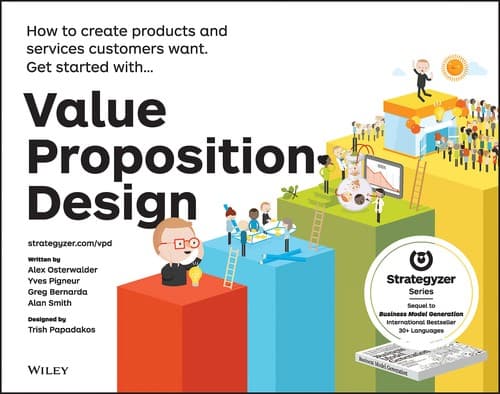
Value Proposition Design, written by Alexander Osterwalder with Yves Pigneur, Gregory Bernarda and Alan Smith, is a practical guide to a question many products quietly fail: does what you offer genuinely matter to the people you want to buy it? It builds on the Business Model Canvas the same team popularized and zooms in on the single area where customers and offerings meet.
The core tool is the Value Proposition Canvas. On the customer side you map the jobs people are trying to get done, the pains that frustrate them, and the gains they hope for. On the offering side you map your products and services, the pain relievers they provide, and the gain creators. The work is to fill in both sides and then judge how well they fit. Much of the book is workbook-style, with templates, exercises and workshop prompts, plus examples that show what a weak match looks like compared with a strong one.
The reading experience is brisk and visual rather than dense. You can get through it in an evening, but the value comes from applying it to a real product, ideally with real customers. It favors testing assumptions over long analysis, so readers hoping for deep theory, market data or financial modeling will find it thin.
Read this if you…
- are building or rethinking a product or service and want a clear way to test whether customers care
- work in a team and need a structured workshop format that non-specialists can follow
- already use the Business Model Canvas and want to go deeper into the customer and offer side
Skip it if you…
- want a deep dive into strategy, competition or market sizing rather than a practical tool
- expect a detailed theory book or a research-backed account of how customers decide
Key Ideas
- 1
Start with the customer's jobs, not your features
The book pushes you to describe what people are trying to accomplish, in their own terms, before you describe what you sell. This shift sounds simple but changes which problems you choose to solve. Features that seemed central often turn out to matter little once you see the underlying job.
- 2
Pains and gains reveal what customers really weigh
Splitting customer frustrations from desired outcomes gives you a more honest picture than a generic list of needs. The framework encourages you to rank what hurts most and what would delight, which helps you decide where to focus effort and where a feature is just decoration.
- 3
Fit between the two canvases is the real goal
The central question is whether your pain relievers and gain creators actually answer the pains and gains you mapped. Many teams produce attractive offers that address the wrong items. The book treats a visible mismatch as useful information rather than a failure of the exercise.
- 4
Test assumptions early and revise often
The authors frame a value proposition as a hypothesis, not a finished answer. They encourage identifying the riskiest assumptions and checking them with cheap experiments and conversations. The emphasis is on learning quickly and changing the proposition, rather than polishing a plan on paper.
Limitations
The canvases can feel formulaic, and some readers find the sticky-note method more useful for teams in workshops than for solo thinking. The book focuses mostly on understanding existing or prospective customers and says little about pricing, financial returns, or how to compete against well-funded rivals. Its tone is upbeat and promotional in places, and its examples lean toward startups and established digital or consumer businesses, which may feel less relevant in heavily regulated or industrial settings.
Questions Readers Ask
- Is Value Proposition Design useful if I'm not a startup founder?
- Yes. The framework applies to new products inside large organizations, service redesigns, and even nonprofit offerings. The tools are about understanding a specific group of people and what would help them, so anyone responsible for a product or service can use them. You may need to adapt the exercises to fit your context.
- How does it compare with the Business Model Canvas?
- The Business Model Canvas gives you a broad view of how a whole business works, from partners to revenue. Value Proposition Design zooms in on one block of that picture, the match between customers and your offer. Many readers use the two together, starting with the wider canvas and then going deeper on the value proposition.
- Is it still relevant, or is it dated?
- The core questions about jobs, pains and gains remain widely useful, and the book's emphasis on testing assumptions fits current product practice. Some examples and references to digital tools reflect the mid-2010s, so treat them as illustrations rather than current benchmarks.
- Published
- 2014
- ISBN
- 9781118968055
- Difficulty
- beginner
- Category
- Business
Book details and cover from Google Books.
Ready to read Value proposition design?
Get your copy on Amazon, or listen to it on Audible. We earn a commission if you buy through these links.