
We earn a commission if you buy through these links. Learn more
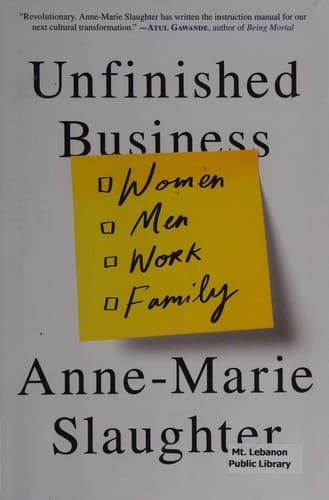
Unfinished business
Guide by the Books of the Day editors · Updated · How we write our guides
A candid, specific case that the modern workplace is built for a worker with no caregiving duties, and what it would take to change that.
What Creators Say About Unfinished business
2 creators reviewed Unfinished business on YouTube between 2018 and 2021, with 244 views between them. Their opinions are their own; we picked these reviews, we didn't write them.
What It's About
Unfinished Business grew out of Anne-Marie Slaughter's 2012 Atlantic essay arguing that women still could not have it all. Slaughter, a Princeton professor and former director of policy planning at the State Department, left a demanding Washington job partly to be more present for her teenage sons. The book widens that personal account into an argument about how work is organized. Despite its Tech category label, it is not about technology; it belongs to the work-and-family literature.
Her approach mixes memoir, stories from other professionals, and policy analysis. She traces how jobs assume a worker who has someone else handling children, elderly relatives, and the household, and why that assumption punishes anyone who lacks such support. The writing is direct and conversational, closer to a long argument with a sharp friend than to an academic study.
Reading it feels urgent and sometimes personal. Slaughter is frank about her own compromises and the guilt many parents carry, and she moves past individual choices toward structural fixes. It rewards readers who already believe the problem is real and want concrete directions, and it asks more patience from readers who are skeptical of the premise.
Read this if you…
- want a serious, policy-minded look at why careers and family life so often collide
- are a parent or caregiver who feels your job was never designed around your life
- manage people or set workplace policy and want concrete ideas you can test
Skip it if you…
- are looking for a book about technology or the future of the tech sector
- want a practical guide to career advancement, negotiation, or promotion tactics
Key Ideas
- 1
The ideal worker assumes someone at home
Many careers are still organized around a worker who can be fully available at all hours, a model that grew out of an era when one partner typically managed the home. Households have changed, but the expectations have stayed largely the same. Slaughter argues this mismatch penalizes anyone with caregiving responsibilities, whatever their gender, and it hurts employers too by wasting talent they have already trained.
- 2
Caregiving is work and deserves value
Raising children and looking after aging parents are necessary labor that society depends on, yet employers and policy often treat them as a private inconvenience. Slaughter contends that this undervaluation shows up in pay, promotion, and who gets sidelined. Taking care work seriously means designing careers so that people can do it without falling off a track they worked hard to reach.
- 3
Men need a larger role too
Slaughter argues that equality will not come from women adapting alone. Men who want to share caregiving often face career penalties and cultural pressure to stay in the traditional provider role. She treats this as a shared problem, since families gain when both partners can take on home responsibilities without losing professional standing.
- 4
Structural change beats individual willpower
The book pushes past advice aimed at individual women to manage their time better or lean in harder. Slaughter focuses on structural levers such as flexible scheduling, paid leave, and rethinking the culture of visible hours at the office. She does not present these as simple to implement, but she makes a persuasive case that they matter more than personal grit.
Limitations
Critics have pointed out that the book speaks mainly to highly educated professionals in demanding jobs, and that Slaughter's own circumstances, including financial resources and a supportive household, shape the perspective. Some readers find the policy proposals broad and not fully worked out. The book is focused on the United States and was published in 2015, so its examples predate the large shift to remote and hybrid work that followed. Its core argument still holds, but the specifics are dated.
Questions Readers Ask
- Is Unfinished Business still relevant after remote work spread?
- Yes, at least in its core argument. The book's examples predate the shift to remote and hybrid work after 2020, but the problem of jobs designed around an always-available worker has not disappeared. Many of its policy ideas, such as flexible scheduling and valuing caregiving, still apply. Pairing it with newer writing on flexibility will show what has changed and what has not.
- How does it compare to Sheryl Sandberg's Lean In?
- Lean In focuses largely on what women can do differently to advance at work. Slaughter is more skeptical that individual effort is enough and argues the workplace itself has to change. Her book is more policy-oriented and more openly critical of the expectations placed on both men and women. If you want systemic analysis rather than personal strategy, Slaughter is the stronger choice.
- Who is this book best for?
- It suits parents and caregivers, managers, and anyone in a demanding job who feels the trade-offs are unfair. It works well for readers who want to understand the structural roots of work-family conflict. It is less useful if you want a step-by-step career manual or a book about technology.
- Published
- 2015
- ISBN
- 9780345812902
- Difficulty
- beginner
- Category
- Tech
Book details and cover from Google Books.
Ready to read Unfinished business?
Get your copy on Amazon, or listen to it on Audible. We earn a commission if you buy through these links.