
We earn a commission if you buy through these links. Learn more
Under the sea-wind
by Rachel Carson, C. M. Hebert
Rachel Carson's first book follows an eel, a mackerel and a gull through the Atlantic seasons, offering lyrical, science-rooted nature writing that shows where her later classics began.
What It's About
Under the Sea-Wind is Rachel Carson's first book, published in 1941, and it reads less like a textbook than a set of linked nature stories. Its focus is the life of the Atlantic coast and open water, told through a few animals: an eel, a mackerel, and a gull. Each moves through the seasons hunting, migrating, and surviving storms and predators, with the sea as constant pressure behind them.
Carson writes in a lyrical, close third-person voice that gives the animals inner lives without turning them into people. The natural history is grounded in the research of her time, and she keeps the drama tied to what actually happens to fish and birds. The prose is dense with sensory detail: the color of water at different depths, the pull of tides, the stillness before a storm. Some passages slow to a crawl, and the sequence of events can feel more like a rhythm than a plot.
Reading it is a quiet, immersive experience rather than a fast one. You come away with a sharper sense of how interconnected coastal life is, and a first look at the writer who would go on to produce The Sea Around Us and The Edge of the Sea. It rewards slow reading and rereading, especially for anyone who likes to watch the natural world closely.
Read this if you…
- love close, sensory nature writing that rewards slow reading
- want to understand how Carson's scientific imagination began
- enjoy stories about animals told with respect for their actual biology
Skip it if you…
- need a fast-moving plot with clear heroes, villains and turning points
- want up-to-date marine science rather than mid-century natural history
Key Ideas
- 1
Animals as participants in a shared world
Carson presents the eel, mackerel and gull as creatures inside one connected environment rather than as isolated specimens. Each animal's choices affect and are affected by the others, so the reader sees the coast as a web of relationships. This framing is the book's central argument, made through story rather than stated outright.
- 2
Migration as the thread through the book
The long journeys animals make, especially the eel's trip toward distant spawning waters, give the book its sense of direction. Migration shows how life depends on movement across vast distances and across seasons. Carson uses these journeys to show that the sea is one system, not a collection of separate habitats.
- 3
Life shaped by the sea's rhythms
Tides, currents, temperature and weather set the terms for every creature's survival. Carson pays close attention to how these forces create opportunity and danger in turn. Readers who notice the physical world closely will find this attention to rhythm one of the book's most rewarding features.
- 4
Survival without sentimentality
Predation and hunger are part of daily life in these pages, and Carson does not soften them. Her animals kill, flee and die in ways that feel natural rather than cruel or heroic. This restraint is what gives the emotional weight to the stories, because the reader feels the stakes without being asked to pity anyone.
Limitations
The book is more than eighty years old, so some of its biology reflects the knowledge of its time, and later research has refined or revised many details. Its pacing is slow, and the connections between chapters can feel loose to readers expecting a conventional novel. The animal narratives are also more atmospheric than analytical. Carson's later nonfiction offers a broader and more systematic account of ocean life, so this book is best read as an introduction to her style and concerns rather than as a complete guide to the sea.
Questions Readers Ask
- Is Under the Sea-Wind a novel or nonfiction?
- It sits between the two. The animals' stories are invented narratives, but they are built on real natural history and observed behavior. Think of it as nature writing in story form rather than a documentary or a conventional novel. Readers who want strictly factual accounts may prefer Carson's later nonfiction, while those who enjoy narrative will find the storytelling the book's main pleasure.
- How does it compare to The Sea Around Us?
- The Sea Around Us is broader and more explanatory, covering the ocean's origins, geology and life as a whole. Under the Sea-Wind is narrower and more intimate, following a few creatures closely. If you want a sweeping overview of the sea, start with The Sea Around Us. If you prefer immersion in individual animal lives, Under the Sea-Wind is the better choice.
- Published
- 1941
- ISBN
- 9781786899279
- Difficulty
- beginner
- Category
- Science
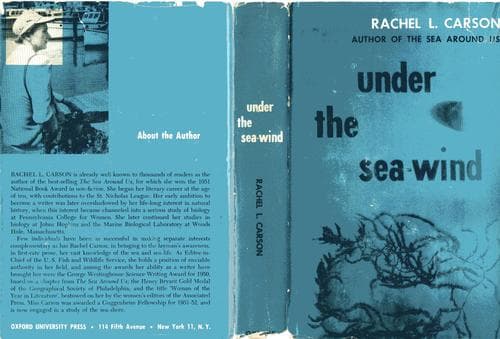
Book details and cover from Google Books.
Ready to read Under the sea-wind?
Get your copy on Amazon, or listen to it on Audible. We earn a commission if you buy through these links.