
We earn a commission if you buy through these links. Learn more
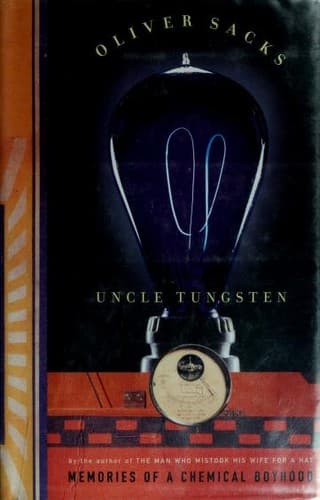
Uncle Tungsten
by Oliver Sacks
Guide by the Books of the Day editors · Updated · How we write our guides
A warm, funny memoir of a bookish London boyhood, where chemistry sets and metal samples become a lens on family, war, and the making of a scientist's mind.
What Creators Say About Uncle Tungsten
2 creators reviewed Uncle Tungsten on YouTube between 2013 and 2019, with 409 views between them. Their opinions are their own; we picked these reviews, we didn't write them.
What It's About
Uncle Tungsten is Oliver Sacks's memoir of his early childhood and adolescence in London, told through his fascination with chemistry and the physical world. Rather than moving in a straight line through his life, the book gathers recollections around particular elements, experiments, and objects, so the periodic table becomes a kind of organizing structure for memory. Sacks writes about the household, his family of doctors and relatives, and the wartime years that shaped the city around him.
The style is conversational and observant. Sacks lingers on the sensory texture of things: the smell of a laboratory, the weight of a metal sample, the small disasters of a home experiment. He is equally attentive to people, and the portraits of relatives give the book its warmth and comedy. The chapters are episodic, so you can read them in sittings without losing the thread.
Reading it feels like sitting with a curious, generous older man who remembers exactly what it was like to be a boy with a question he could not stop asking. It is less a science book than a book about how a scientific temperament forms, and it rewards readers who enjoy memoir more than explanation. Expect gentle digressions into the history of chemistry rather than a rigorous technical treatment.
Read this if you…
- enjoy memoirs about childhood and family more than straightforward science writing
- are curious how a scientist's early obsessions take shape
- like warm, observant prose with plenty of digressions and vivid details
Skip it if you…
- want a clear, structured explanation of chemistry or the periodic table
- need a tightly plotted narrative with a strong through-line
Key Ideas
- 1
Chemistry as a way of seeing childhood
Sacks uses the elements and laboratory work as a frame for his memories. Each substance becomes an entry point into a person, a place, or a moment, which makes the childhood feel organized by curiosity rather than by dates.
- 2
Objects that carry family history
Metals, tools, and household equipment recur throughout the book and connect to relatives' working lives. The physical things he handles become a way of understanding the people who shaped his interests and expectations.
- 3
The making of a scientific temperament
A large part of the book traces how patient observation, hands-on tinkering, and a taste for systematic order first took hold. It shows how early fascinations can quietly determine a later vocation, including the path toward medicine and writing.
- 4
Wartime London seen through a child's eyes
The disruptions of the war appear as background texture rather than as the main subject. Sacks shows how a child absorbs danger, loss, and uncertainty while still finding room for wonder and play.
- 5
Humor and tenderness in ordinary life
The book is funny in a dry, affectionate way. Its portraits of eccentric relatives and its honest account of childhood mistakes keep the memoir lively and prevent the nostalgia from becoming sentimental.
Limitations
The episodic structure can feel loose to readers who want a conventional life story with clear chronology. Some chemistry is described in terms of wonder and anecdote rather than rigorous explanation, so scientifically minded readers may want more depth. Because it covers only the early part of Sacks's life, it does not tell the full story of his medical career or his later case-study books. Some period attitudes toward family, school, and gender also feel dated to contemporary readers.
Questions Readers Ask
- Is Uncle Tungsten a good place to start with Oliver Sacks?
- It can be, especially if you enjoy personal writing more than case studies. It shows his warmth and curiosity before his later books on neurology. If you want his clinical stories first, Awakenings or The Man Who Mistook His Wife for a Hat are more typical entry points. Uncle Tungsten suits readers who want to understand where his sensibility came from.
- Do I need a background in chemistry to enjoy it?
- No. The chemistry serves as a memory device and a source of wonder rather than a technical lesson. You will follow the book without any formal training. Readers with some interest in the subject will likely appreciate the historical details and the sense of discovery more, but the core appeal is the people and the childhood atmosphere.
- How does it compare to Sacks's other books?
- It is much more personal and less clinical than his neurology case studies. Where those books focus on patients and the brain, this one focuses on his own developing mind and family. Readers who love his clinical writing sometimes find the memoir slower, but it deepens appreciation for his curiosity and humane tone.
- Published
- 2001
- ISBN
- 9781509813698
- Difficulty
- beginner
- Category
- Science
Book details and cover from Google Books.
Ready to read Uncle Tungsten?
Get your copy on Amazon, or listen to it on Audible. We earn a commission if you buy through these links.