
We earn a commission if you buy through these links. Learn more
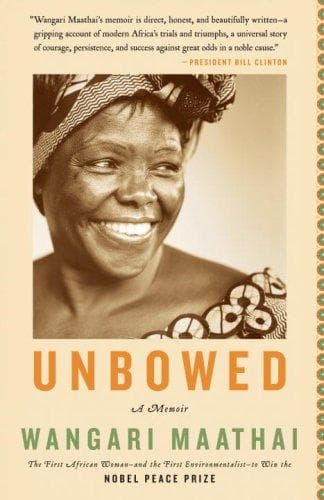
Unbowed
Maathai's memoir shows how planting trees became a fight for democracy and women's rights in Kenya, told by the Nobel laureate with unusual candor and grit.
What It's About
Unbowed is Wangari Maathai's memoir, published in 2006, two years after she received the Nobel Peace Prize. It follows her from a childhood in rural central Kenya, through her education in the United States and Germany, to her return home as a rare woman academic and the founder of the Green Belt Movement. The story is organized around the arc of her life rather than a single argument, so the reader moves through family history, university politics, community organizing and her long standoffs with the government.
Her voice is direct and personal. Maathai writes as someone telling her own story to a listener she trusts, and she is willing to describe humiliation, fear and self-doubt alongside the wins. Some passages carry the rhythm of a speech, and she returns often to the values that shaped her, including faith, hard work and a sense of duty to ordinary villagers. Reading it feels less like studying a movement from outside and more like sharing a kitchen table with a determined, sometimes blunt woman.
It is worth knowing that the Science category label is misleading. The book is not a science text; ecology appears as lived practice, seedlings in the ground and land that is being lost, rather than as technical argument. Expect a memoir about activism, politics and gender, with a didactic streak in places.
Read this if you…
- want a first-hand account of grassroots environmental organizing in Africa
- are interested in how a civic movement survives political hostility
- want a memoir of an African woman's public life written in plain, direct language
Skip it if you…
- want technical environmental science, ecology or climate data
- prefer memoirs focused on private emotional life rather than public causes
Key Ideas
- 1
Trees as a practical starting point
The Green Belt Movement began with a simple task: planting seedlings. Maathai shows how that modest act tied together soil, water, firewood and small incomes, giving rural women a reason to organize. The book makes clear that the planting was never only about forests; it was a way of building trust and collective confidence in communities that had little voice.
- 2
Environment and politics are inseparable
Her clashes with officials over forest land and public green space show how environmental questions quickly became political questions about who controls resources. The memoir traces how protecting trees turned into a challenge to authoritarian rule, and how ordinary citizens could be pulled into that confrontation without having planned it.
- 3
Gender and the cost of public leadership
Maathai pays close attention to how women leaders were dismissed, mocked or treated as unfit for serious work. She describes the strain this placed on her family life and her marriage, and how she responded with a mix of defiance and deliberate restraint. These passages add a personal dimension to the wider story of her public career.
- 4
Persistence as a working method
Much of the book is about returning to the same fight after setbacks, including arrests, public attacks and funding or policy reversals. Maathai presents persistence as a discipline grounded in faith and community ties rather than in a single heroic moment, which gives the narrative its steady, cumulative feel.
Limitations
The book is shaped entirely by Maathai's own view, so rivals, allies and internal disputes within her movement appear mainly as she saw them. Readers who want context on Kenyan politics may need outside reading to follow the names and events. The prose is earnest and sometimes repetitive, and a few passages lean toward moral instruction more than narrative. Because it was published in 2006, it stops before her final years and does not reflect later debates about the movement's direction.
Questions Readers Ask
- Who is this book best suited to?
- Readers new to Kenyan politics or environmental activism who want an accessible, first-hand account will find it rewarding. Those who want a balanced history of the Green Belt Movement or of Kenya's political era will need additional sources, since the book reflects one central voice.
- How does it compare to other activist memoirs?
- It is less polished and more openly political than many celebrity-style memoirs, and less analytical than academic histories of the movement. Its main appeal is the sense of a single voice speaking with conviction about a long, difficult struggle.
- Is it still relevant today?
- Yes, especially for its questions about land, forests and civic resistance to authoritarian rule. The specific political details belong to a particular era, but the broader themes of community organizing and environmental responsibility remain current.
- Published
- 1999
- ISBN
- 9780307263483
- Difficulty
- beginner
- Category
- Science
Book details and cover from Google Books.
Ready to read Unbowed?
Get your copy on Amazon, or listen to it on Audible. We earn a commission if you buy through these links.