
We earn a commission if you buy through these links. Learn more
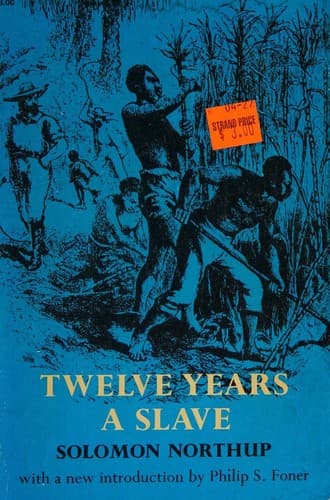
Twelve years a slave
A free New Yorker's sworn account of being kidnapped into slavery and the plain, unsparing record of what he saw in the Louisiana cotton country.
What It's About
Solomon Northup was a free Black man from Saratoga, New York, a fiddler and family man who in 1841 accepted a short paid engagement in Washington, D.C. Instead of work, he was drugged, according to his account, and sold south. The book, published in 1853 after he regained his freedom, covers the twelve years he spent enslaved in Louisiana, mostly around the Red River and Bayou Boeuf.
The approach is that of a witness giving testimony rather than a reflective essay. Northup presents himself as a man who had known freedom, so he can measure exactly what was taken from him: his name, his family contact, his legal standing, and his time. He narrates labor, sale, discipline, and daily routine in concrete detail. The opening pages include documents meant to establish who he was, which signals that the book was written to persuade a public that could still doubt such stories. David Wilson, who helped shape the text, is credited as editor, and how much his hand influenced the prose is debated.
Reading it is a brisk, sometimes flat, often gripping experience. Long stretches are about work and the calendar of the plantation, and the violence is described plainly rather than luridly, which makes it harder to put down than a more dramatic account would be. It is one man's view from a particular region, not a survey of slavery, and that narrowness is part of its force.
Read this if you…
- want a firsthand account of slavery in the American South from someone who had lived as a free man
- are interested in how legal documentation and public persuasion shaped 19th-century abolitionist writing
- prefer plain, concrete description over lyrical or theoretical prose
Skip it if you…
- want a broad overview of American slavery across regions and centuries, since this book covers one man and a few plantations
- need a neutral, fully modern voice, because the 19th-century formality and the author's own attitudes can be jarring
Key Ideas
- 1
Freedom as the measure of loss
Because Northup was born free and knew what liberty meant in practice, he can describe enslavement as a set of specific losses rather than an abstract condition. He notes the loss of legal existence, of contact with his family, and of the ordinary dignity of choosing how to spend a day. This gives his account a clarity that writers who were born into bondage could not always offer in the same way.
- 2
A documentary witness, not a confession
The book is built to persuade. Northup assembles his identity, his kidnapping, and his eventual rescue into a case a skeptical reader could follow. Its authority comes from specificity and from the framing of a legal record, not from introspection. Expect names, places, and procedures rather than long passages of self-examination.
- 3
Ordinary routine as the horror
Much of the book's power comes from showing how cruelty was built into daily work: quotas, weather, supervision, and the constant threat of punishment. Northup does not rely on lurid scenes alone. He shows that brutality was an administrative fact of the plantation, which makes the everyday details more unsettling than any single incident.
- 4
Survival through small acts and networks
Northup records the ways enslaved people looked after one another, shared information, and made small accommodations. He also shows how little any one person could change. Readers interested in how survival worked within constraints will find this thread as important as the larger narrative of his capture and rescue.
Limitations
The book is one man's experience in a specific part of Louisiana, so it cannot stand in for a general history of slavery. Northup's own attitudes sometimes reflect the prejudices of his time, including distance from other enslaved people and condescension toward some of them, which modern readers notice and should weigh. The extent of David Wilson's editorial shaping is debated, and the 19th-century prose can feel formal. Its emotional content is hard, and some passages are painful to read.
Questions Readers Ask
- Is Twelve Years a Slave still worth reading today?
- Yes. It remains one of the most direct first-person accounts of American slavery in print, and it is widely taught. Read it alongside more recent historical work to test its claims against broader evidence, and to see how the experience of one man fits into the larger system. Its specificity is what keeps it relevant.
- How does the book compare to the 2013 film?
- The film, directed by Steve McQueen and adapted from the book, is more visually intense and compresses events for dramatic effect. The book offers more detail on daily routines, the legal process of his rescue, and the texture of his years in between. Many readers find the book slower but richer in the specifics of ordinary life.
- Published
- 1853
- ISBN
- 9781539032854
- Difficulty
- beginner
- Category
- History
Book details and cover from Google Books.
Ready to read Twelve years a slave?
Get your copy on Amazon, or listen to it on Audible. We earn a commission if you buy through these links.