
We earn a commission if you buy through these links. Learn more
Tunnel in the sky
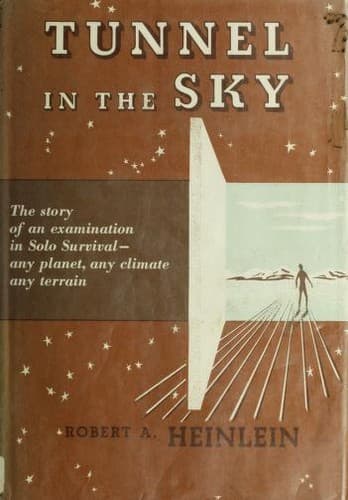
A 1955 Heinlein juvenile where a survival exam goes wrong and stranded teenagers must build their own society, making it a quick, idea-driven read about competence and self-government.
What It's About
Tunnel in the Sky is a 1955 young-adult science fiction novel by Robert A. Heinlein, written as one of his juveniles. Its premise is a final exam: teenagers from a future human society must survive alone for a week on an unmapped, hostile world, reached through a gateway called the Tunnel. The protagonist, Rod Walker, is a capable, ordinary kid who expects a routine trial, and the novel's opening pleasure is watching how seriously it takes the practical details of getting by.
The style is brisk, plain, and practical. Heinlein writes in short scenes, focuses on tools, food, water, weather, and decisions, and conveys emotion mostly through action rather than introspection. Once the group is stranded, the story becomes a series of small experiments in government, with different clusters of students trying different ways of distributing work, handling disagreement, and deciding who is responsible for whom. Reading it feels like a camping trip crossed with a civics seminar, and the lecturing sometimes shows through.
It is short enough to finish in an evening or two and rewards readers who enjoy competence-focused adventure. Heinlein's voice is confident and occasionally didactic, which some readers find charming and others find heavy-handed. Do not expect deep interiority or literary experimentation. The pleasure lies in the problems and the ideas they provoke.
Read this if you…
- enjoy survival stories where the problem-solving is the point
- are curious how groups build order when institutions fall away
- want an accessible classic of golden-age science fiction
Skip it if you…
- need rich characterization or emotional depth from your protagonists
- are put off by lecture-like passages of political argument inside fiction
Key Ideas
- 1
Competence as the measure of a person
The book treats self-reliance as a practical skill rather than a personality trait. Rod is judged on whether he can find water, build shelter, navigate, and keep his head under pressure. The story keeps asking what an education is for if it cannot produce people who function when nobody is in charge, and much of the plot is simply practical problem-solving under real constraints.
- 2
Government built from nothing
When the students are stranded, they do not simply fall into chaos. They try to build political order from scratch, and the novel runs several small experiments in leadership and authority, comparing how each group allocates labor and treats members who cannot pull their weight. Heinlein is plainly testing ideas about individual liberty and obligation, so readers who enjoy political thought will find more to argue with than in a typical adventure novel.
- 3
Youth facing adult responsibility
The protagonists are teenagers who must act like adults without the usual safety net. The book takes their capability seriously, which gives it an encouraging tone for young readers, while also showing how quickly groups fracture when fear and pride take over. Its coming-of-age arc is about learning when to lead and when to follow.
- 4
Plain prose as a design choice
Heinlein writes in a clear, economical style built around procedures and decisions. Scenes move quickly, descriptions of terrain and equipment stay functional, and the emotional core is carried by what characters do. This keeps the book easy to follow, but readers seeking lyrical description or deep psychological interiority will find it spare.
Limitations
Heinlein's juvenile fiction of this period shows its age. Gender roles are narrow, with female characters given limited agency and roles that feel dated by modern standards. Many characters are sketches more than fully realized people, and the political debates can read as the author's own views delivered through dialogue. The science and technology reflect 1950s assumptions and are out of date in places, though this rarely undermines the adventure. Readers should approach it as a product of its time.
Questions Readers Ask
- Is Tunnel in the Sky suitable for young readers?
- Yes. It was written as a juvenile and its protagonist is a teenager. Its violence is limited and its focus is on survival and decision-making, so it works well for middle-grade and young adult readers. Adults who enjoy classic science fiction will also find it quick and engaging, though they may notice the dated attitudes more than younger readers do.
- How does it compare to Heinlein's Have Space Suit, Will Travel?
- Have Space Suit, Will Travel is lighter, more comic, and more gadget-driven. Tunnel in the Sky is more sober and focused on social organization. It asks more directly what people owe one another when the rules disappear, so readers who want humor and adventure may prefer the other book, while those interested in ideas may prefer this one.
- Published
- 1955
- ISBN
- 9780345281951
- Difficulty
- beginner
- Category
- Fiction
Book details and cover from Google Books.
Ready to read Tunnel in the sky?
Get your copy on Amazon, or listen to it on Audible. We earn a commission if you buy through these links.