
We earn a commission if you buy through these links. Learn more
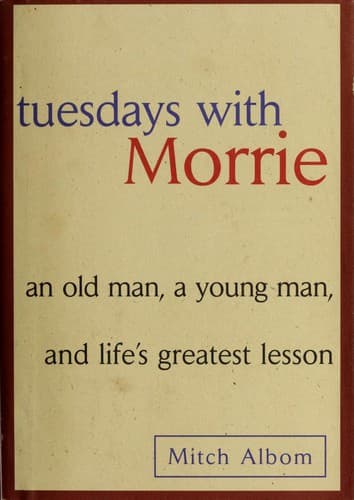
Tuesdays with Morrie
by Mitch Albom
Guide by the Books of the Day editors · Updated · How we write our guides
A short, tender memoir of weekly visits with a dying former professor, offering plain-spoken reflections on love, work, and living fully that have made it widely read.
What Creators Say About Tuesdays with Morrie
2 creators reviewed Tuesdays with Morrie on YouTube between 2018 and 2024, with 152.7K views between them. Their opinions are their own; we picked these reviews, we didn't write them.
What It's About
Tuesdays with Morrie is Mitch Albom's memoir of the last months of his former college professor, Morrie Schwartz, who was dying of ALS. Albom had lost touch with Morrie after graduating from Brandeis, then reconnected after seeing him on television. From that point on, Albom visited his old teacher every week, and the book records those conversations.
The structure is simple. Each section centers on a subject Morrie wants to talk about, such as fear, money, marriage, family, and aging, and Albom weaves in his own life, including his career and his sense that work had crowded out the people he cared about. The prose is direct and conversational, closer to a long, warm talk than to literary craft, and the reader spends the book in an unhurried room with a teacher and his student.
Reading it feels brief, gentle, and often moving. It asks little of you technically and more of you emotionally. Morrie's voice carries most of the book, and many of his lines are built to be remembered, which is part of its appeal and part of its limit.
Read this if you…
- want a short book you can finish in a sitting or two
- are grieving or caring for someone who is dying and want a gentle, honest companion
- prefer warm, plain-spoken wisdom to dense argument or technical detail
Skip it if you…
- want a detailed account of ALS, its treatment, or the health care system around it
- find sentimental, aphoristic writing hard to take seriously
Key Ideas
- 1
Living fully while facing a terminal illness
Morrie treats his dying as a stage of living rather than a countdown to be endured. The book shows how paying close attention to ordinary days, relationships, and small pleasures can change what a final stretch of life feels like, both for the person dying and for those beside them.
- 2
A critique of a culture built on accumulation
Morrie argues that chasing money, status, and possessions leaves people hollow, and he sees modern consumer life as a misreading of what matters. These passages are the most pointed in the book, though they are offered as personal conviction more than as detailed social analysis.
- 3
Love, family, and making peace with the past
A large share of the conversations concern marriage, parenting, and forgiveness. Morrie frames these relationships as the place where meaning is most reliably found, and he encourages Albom to reconsider old resentments and the way he has been living.
- 4
Facing the fear of aging and decline
Morrie speaks candidly about the fear that comes with growing older and losing control of the body. His approach is to name the fear, examine it, and accept dependence on others as part of being human, rather than as a failure.
- 5
The teacher-student bond as the book's frame
Much of the emotional force comes from the relationship itself and from Albom's own reckoning with it. The book works as a portrait of a mentor and of what a former student owes the people who shaped him.
Limitations
Many critics find the book sentimental, and its advice on love, mortality, and meaning often repeats familiar ideas without much challenge. Morrie's outlook comes from a comfortable, educated life, and the book says little about disability, the cost of caregiving, or how people with fewer resources experience dying. Albom also places himself near the center of the story at points, which some readers find distracting from Morrie's own perspective.
Questions Readers Ask
- Is Tuesdays with Morrie still worth reading today?
- Yes, for readers who want a personal reflection on mortality, relationships, and purpose. Some of its cultural critiques about money and consumer life feel dated, and its picture of ALS care reflects the late 1990s. The emotional core, however, still lands for most readers.
- How does it compare to Being Mortal by Atul Gawande?
- Gawande's book is an investigation of medicine and end-of-life care, built on research, case studies, and policy analysis. Albom's is an intimate, personal account of one relationship. Read Gawande if you want to understand the systems around dying, and Albom if you want to sit with the human side of it.
- Is it a good gift for someone who is grieving?
- Many readers find it comforting because it is short, unclinical, and focused on love and presence. Some grieving readers find its tidy lessons too neat, so it works best for someone who is open to reflective, uplifting writing rather than practical grief guidance.
- Published
- 1994
- ISBN
- 9785403034128
- Difficulty
- beginner
- Category
- Biographies
Book details and cover from Google Books.
Ready to read Tuesdays with Morrie?
Get your copy on Amazon, or listen to it on Audible. We earn a commission if you buy through these links.