
We earn a commission if you buy through these links. Learn more
Tuesday
Guide by the Books of the Day editors · Updated · How we write our guides
A wordless Caldecott winner that turns a quiet night into a sly, wondrous story, rewarding slow looking and inviting readers to write the narrative themselves.
What Creators Say About Tuesday
2 creators reviewed Tuesday on YouTube between 2011 and 2020, with 447.7K views between them. Their opinions are their own; we picked these reviews, we didn't write them.
What It's About
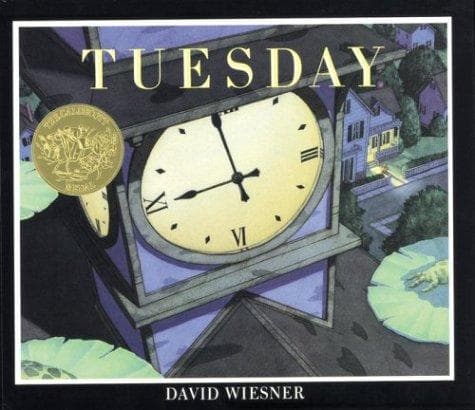
Tuesday is a wordless picture book by David Wiesner, and it shows how much a picture book can do without a single line of text. The premise is simple: on one night, a group of frogs drifts out of their pond, riding their lily pads through the air above a sleeping town. What follows is a sequence of small, surprising images as they move past windows, rooftops, and a few startled onlookers.
Wiesner's watercolor art carries nearly all the weight. Each spread is carefully composed, so readers who linger notice details the characters themselves seem not to see, and the pages reward a second and third look. The pacing is quiet and deliberate, closer to a dream or a slow film than an action story. The book leaves gaps for you to fill, deciding what the frogs feel and what happened between one scene and the next.
Reading it feels less like following a plot and more like being let in on a private joke with the illustrator. A first pass takes only minutes, but adults and children tend to stay longer, talking through what they see. It works especially well read aloud as a conversation rather than a story with words.
Read this if you…
- enjoy visual storytelling and like reading illustrations closely
- want a gentle, funny book to share with a child or to revisit yourself
- are curious about how picture books work as an art form
Skip it if you…
- need a plot with clear stakes, a firm resolution, and a defined cast of characters
- want a long, text-rich reading experience
Key Ideas
- 1
Storytelling carried entirely by images
Without text, Wiesner builds the plot through composition, perspective, and sequence. Each page shifts the viewpoint so the story moves forward visually. The book shows how a single image can imply cause, effect, and mood, which makes it a useful case study for anyone curious about how picture books actually function.
- 2
Wonder found in the ordinary
The setting is a familiar, unremarkable town, and the humor and magic come from seeing it turned slightly askew. The book does not explain its premise. It simply presents the strange event as matter-of-fact, and that restraint is much of its charm.
- 3
Details that reward rereading
Background elements and small moments recur across spreads, so the book reads differently on each visit. Children often spot things adults miss, and adults often find layers of humor that work below a child's notice. Rereading is part of the experience rather than an optional extra.
- 4
The reader as co-author
Because the book withholds explanation, readers must decide what the events mean and how the characters respond. Two readers can come away with different stories, and that openness is the point. The book trusts its audience to interpret rather than to be told.
Limitations
Some readers find the story slight, since it offers little in the way of backstory, character development, or explanation. Its meaning is deliberately open, which delights some readers and frustrates others who want a clear payoff. Very young children may need an adult to narrate the pages, because the sequence depends on following visual cues. The watercolor style is distinctive and well suited to its era, but it may not appeal to readers who prefer more modern or photographic illustration.
Questions Readers Ask
- Is Tuesday suitable for adults or only for children?
- It suits both. Children enjoy the frogs and the sense of mischief, while adults often notice the composition, the humor in the background, and the quiet tone. Many readers find they get something different on each reading, which is why it works well across ages.
- Why did Tuesday win the Caldecott Medal?
- The Caldecott Medal honors the most distinguished American picture book illustration of the year. Tuesday earned it for the way its art tells a complete, inventive story without words, using composition and sequence to create wonder and humor.
- What should I read after Tuesday?
- Wiesner's other wordless books, such as Flotsam, are a natural next step if you enjoy this one. Readers who like the idea of illustrators leaving gaps for the audience to fill may also enjoy other wordless picture books that depend on careful, detailed artwork.
- Published
- 1987
- ISBN
- 9780780784352
- Difficulty
- beginner
- Category
- Fiction
Book details and cover from Google Books.
Ready to read Tuesday?
Get your copy on Amazon, or listen to it on Audible. We earn a commission if you buy through these links.