
We earn a commission if you buy through these links. Learn more
Treasure Island
Guide by the Books of the Day editors · Updated · How we write our guides
Stevenson's pirate classic remains the blueprint for adventure fiction: a boy, a treasure map, and a charming, dangerous cook whose loyalties you will never fully read.
What Creators Say About Treasure Island
2 creators reviewed Treasure Island on YouTube between 2016 and 2017, with 436.4K views between them. Their opinions are their own; we picked these reviews, we didn't write them.
What It's About
Treasure Island is a novel first published in 1883 and written as a boys' adventure, though adults read it just as eagerly. Its narrator, Jim Hawkins, is a young innkeeper's son on the English coast who comes into possession of an old sailor's chart marked with buried treasure. With the help of a squire and a doctor, Jim joins an expedition on a sailing ship, and the crew he ends up with is a mix of hard men and a few who are not what they seem.
The book is told in the first person, with Jim looking back on events he lived through. His voice is candid, sometimes naive, and often funny, and the sentences are plain and quick. Chapters are short and move forward with urgency, so the reading experience feels closer to a fast-moving film than to a slow literary novel. Much of the tension comes from uncertainty about whom to trust, and the sea-going details feel lived in.
Do not expect deep psychological portraits. Most characters are drawn with bold strokes, and the emotional payoff lies in courage, loyalty, and the sudden shift from boyhood toward adulthood. Long John Silver is the exception, a figure vivid enough to have shaped how readers picture pirates ever since.
Read this if you…
- want a fast, suspenseful adventure with a strong sense of place at sea
- enjoy morally complicated villains who are harder to hate than expected
- are curious where modern pirate stories and their stock characters originally came from
Skip it if you…
- need complex psychological characters or a slow, layered literary style
- want a story with major roles for women or a modern take on colonial history
Key Ideas
- 1
Long John Silver as a morally tangled figure
Silver is charming, capable, and warm toward Jim, yet he is also a dangerous man with a criminal past. The book never settles the question of where his loyalties lie, which is why he remains the most memorable character. Readers tend to finish the novel still debating him, and that ambiguity is a large part of the book's lasting appeal.
- 2
Trust and betrayal in a confined space
A ship is a small world with no escape, so every alliance matters. Stevenson uses the cramped setting to build suspense, as Jim must decide repeatedly whom to believe. The tension comes less from big battles than from conversations, overheard words, and the slow realization that the people around you may be hiding something.
- 3
Coming of age through Jim's eyes
Jim begins as a passive boy who is carried along by events, but the story pushes him toward judgment and courage. His retrospective narration gives the adventure a reflective edge, because he understands what he did not see at the time. This gives the book a quiet emotional arc beneath the action.
- 4
Shaping the modern pirate adventure
Many of the pirate conventions people now take for granted, from the sea chest and the parrot to the grog-soaked crew and the sinister one-legged cook, were fixed in the popular imagination by this novel. Reading it shows where these images came from and how much of the genre still leans on Stevenson's choices.
Limitations
The novel reflects the attitudes of its era, and some depictions of race, violence, and empire will strike modern readers as dated or uncomfortable. Many characters are sketched rather than developed, and the female characters are almost absent. Some dialogue is heavy with sailors' dialect, which can slow reading. Readers expecting realistic naval detail or a nuanced treatment of piracy may find the book more romantic than accurate.
Questions Readers Ask
- Is Treasure Island suitable for adults, or only for children?
- It is written in a style that suits younger readers, but adults often enjoy it more than they expected. The moral ambiguity, especially around Long John Silver, and the craft of the suspense give grown readers plenty to think about. It is short enough to finish in a few sittings, which makes it an easy return to a classic.
- How does it compare with Stevenson's Kidnapped?
- Treasure Island is faster and more openly theatrical, with a clearer sense of a treasure-hunting plot. Kidnapped is more grounded in the Scottish landscape and history, and its pacing is more deliberate. If you liked the boyish voice and the sea setting here, Kidnapped is a natural next read.
- Published
- 1880
- ISBN
- 9798695545791
- Difficulty
- beginner
- Category
- Fiction
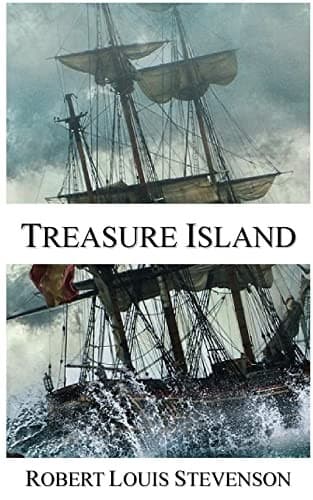
Book details and cover from Google Books.
Ready to read Treasure Island?
Get your copy on Amazon, or listen to it on Audible. We earn a commission if you buy through these links.