
We earn a commission if you buy through these links. Learn more
Travels with Charley
Steinbeck's late-life road trip across America, with his poodle and a camper truck, offers a warm, observant look at the country in 1960 and at the author himself.
What It's About
Travels with Charley is usually shelved as a biography, but it is closer to a travel memoir. In 1960, John Steinbeck, then in his late fifties and in poor health, set out to see the United States again after years away. He outfitted a pickup truck with a camper shell, which he named Rocinante after Don Quixote's horse, and took along his French poodle, Charley. The book records the route, the weather, the diners and motels, and the people he met along the way.
The approach is loose and conversational. Steinbeck mixes close description of landscapes and small towns with reflections on what he sees and what it says about the country. He is a sharp observer of regional differences and of ordinary people's habits, and he writes with the affection of someone who still loves what he is looking at, even when it disappoints him. Charley is a steady presence, and the dog's behavior gives the narrative its humor.
Reading it feels like sitting with an older, curious traveler who talks as he drives. The pace is unhurried and the prose is plain. It is a book to read in pieces, and it rewards readers who enjoy atmosphere and personal observation more than plot or argument.
Read this if you…
- enjoy relaxed, observational travel writing about the United States
- like books that mix personal reflection with scenes of everyday life
- want a warm, slightly wistful portrait of an author near the end of his career
Skip it if you…
- want a rigorous history or a detailed biography of Steinbeck's life
- need a clear, accurate record of every place and event, since the account has been questioned
Key Ideas
- 1
A search for the country as it actually is
Steinbeck frames the trip as a way to reconnect with an America he feels he has lost touch with. He is less interested in famous sites than in ordinary towns, roads, and conversations, and he uses those details to test his sense of national character.
- 2
Solitude and the comfort of a companion
Much of the book is about traveling alone in a small vehicle. Charley gives him someone to talk to and a reason to stop, and the dog's presence shapes how strangers respond to him. The loneliness of the road is a recurring undercurrent.
- 3
Regional differences and the American mood
Steinbeck pays close attention to how places feel, from the northern woods to the Pacific coast to the South. He notices shifts in speech, manners, and attitudes, and he treats them as clues to what people value and fear in 1960.
- 4
Memory, aging, and looking back
The trip is also a reflective exercise. Steinbeck thinks about his earlier life, his writing, and the passage of time. These passages give the travelogue an elegiac tone that sets it apart from a simple account of places visited.
Limitations
The book reflects the perspective of a white, male, well-off traveler in 1960, and it shows that vantage. Steinbeck's engagement with Black Americans and with the civil rights struggle in the South is thin, and some passages on race and regional stereotypes read poorly today. Later scholarship has also questioned how closely the account follows the actual route and timeline, and some episodes appear shaped for effect. Readers looking for a factual itinerary or a balanced view of the period should look elsewhere.
Questions Readers Ask
- Is Travels with Charley really a biography?
- Not in the usual sense. Although it is shelved under biography in some catalogs, it is a travel memoir about a road trip Steinbeck took across the United States in 1960. It does include reflections on his life, but its main subject is the journey and the country he saw along the way.
- Is it still worth reading today?
- Yes, especially if you enjoy travel writing and want a snapshot of American life in the early 1960s. Some of its views on race and regional attitudes feel dated, so read it with that context in mind. Its observations about landscape, small-town life, and loneliness on the road still hold up well.
- How does it compare to Bill Bryson or Paul Theroux?
- Steinbeck is gentler and more reflective than either. Bryson is funnier and more joking, while Theroux is often more critical and harder on the places he visits. If you want a warm, wistful road narrative with a companion dog, Steinbeck is the choice.
- Published
- 1962
- ISBN
- 9788483078594
- Difficulty
- beginner
- Category
- Biographies
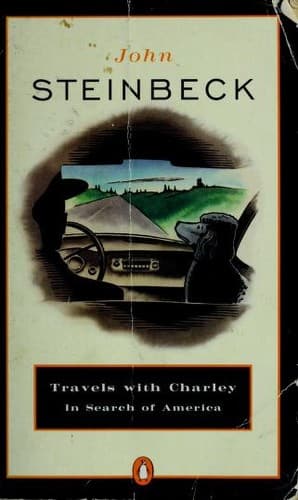
Book details and cover from Google Books.
Ready to read Travels with Charley?
Get your copy on Amazon, or listen to it on Audible. We earn a commission if you buy through these links.