
We earn a commission if you buy through these links. Learn more
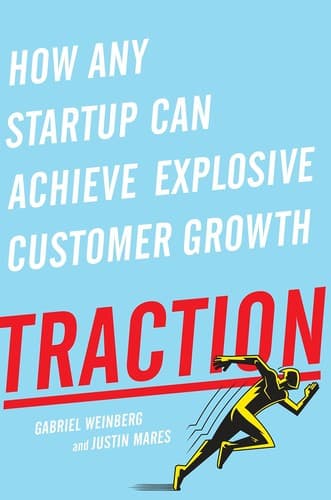
Traction
A short, testable method for finding the marketing channels most likely to win a startup its first customers, built around nineteen concrete options.
What It's About
Traction is a practical business book about the question many early founders get wrong: not how to build something people like, but how to acquire customers in a way you can repeat. Gabriel Weinberg, who built the search engine DuckDuckGo, wrote it with Justin Mares. Its core is a framework the authors call the Bullseye: list every plausible way your company could reach customers, rank those options, then test the most promising ones in order to find the one or two that actually work.
The bulk of the book is a catalog of nineteen traction channels, ranging from paid advertising and search optimization to partnerships, public relations, and community building. Each channel gets a brisk treatment that explains what it is good for, what it demands, and how a small team might test it before committing real money or months. The tone is businesslike. Ideas are framed as steps and checklists rather than abstract theory, and many company examples show the method in action.
Reading it feels like sitting in on a strategy workshop. It is short enough to finish in an evening or two, and it rewards a pen, because the most useful exercise is ranking channels against your own product, budget, and stage. Expect less on why a product should exist and more on what to try next week.
Read this if you…
- are building an early-stage company and need a realistic plan for getting customers
- want a structured way to decide where to spend a limited marketing budget
- prefer short, action-oriented business books with checklists over long theoretical arguments
Skip it if you…
- already have a mature, well-funded growth team and want deep analysis of attribution or pricing
- are looking for a narrative book with stories about founders' personal struggles
Key Ideas
- 1
Traction matters more than the product
The book starts from the observation that many young companies fail not because their product is weak but because too few people ever find it. Growth is treated as a problem to be solved deliberately, with its own tools and experiments, rather than something that will happen once the product is good enough. That shift in attention is the book's most useful reframing for founders who assume great software sells itself.
- 2
The Bullseye framework for choosing channels
Instead of picking a marketing channel based on instinct or fashion, the method asks you to brainstorm widely, then narrow the list through ranking and cheap tests. Channels that show early signs of working move into focus, while the rest are set aside. The approach forces a team to commit to a small number of experiments at a time, which keeps effort from being scattered across too many ideas at once.
- 3
Nineteen channels to consider
The catalog is the book's practical backbone. Each channel is described in terms of how it tends to work, what kinds of businesses have used it successfully, and what early signals to watch for. Its real value is breadth: many founders default to one or two familiar options, and seeing the full range makes it easier to spot overlooked routes to customers that fit your situation.
- 4
Test cheaply and measure cost per customer
The authors push teams to run small, time-boxed experiments with clear targets, such as a maximum cost per acquired customer. A channel that cannot meet its target after a fair test should be dropped quickly, and a channel that clears it can be scaled. The discipline is simple to state and hard to follow, which is why the book spends so much effort on setting up measurable experiments.
Limitations
Many examples come from venture-backed software and consumer internet companies, so founders in physical products, local services, or regulated industries may find some channels less relevant. The specific tactics are tied to platforms and advertising systems that change quickly, so parts of the channel descriptions will date faster than the underlying logic. The book also says relatively little about pricing, product design, or long-term brand building, and several recommended tests assume you can afford to spend money learning.
Questions Readers Ask
- Is Traction still relevant after recent changes to online advertising?
- The core method still holds, since ranking channels and testing them cheaply is independent of any single platform. The specific tactics, especially around paid social and search advertising, are more dated. Treat the channel descriptions as starting points and check current platform rules and costs before running any experiment.
- How does Traction compare to Crossing the Chasm?
- Crossing the Chasm focuses on how a product moves through stages of market adoption and why early customers differ from mainstream ones. Traction is narrower and more tactical, concentrating on which acquisition channels to try and how to test them. Readers who want strategy for positioning will find Crossing the Chasm more useful, while Traction suits teams deciding what to do next.
- Published
- 2014
- ISBN
- 9780241242544
- Difficulty
- beginner
- Category
- Business
Book details and cover from Google Books.
Ready to read Traction?
Get your copy on Amazon, or listen to it on Audible. We earn a commission if you buy through these links.