
We earn a commission if you buy through these links. Learn more
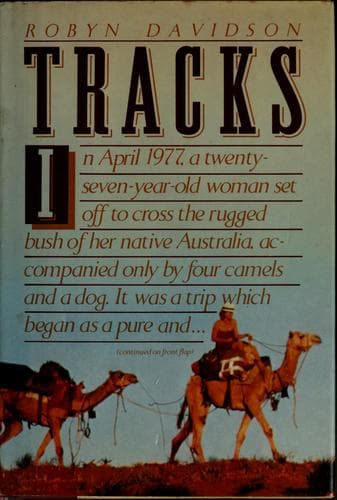
Tracks
Guide by the Books of the Day editors · Updated · How we write our guides
A spare, unsentimental account of a woman's solo trek across the Australian desert with camels, and a sharp look at solitude, attention, and the land's first people.
What Creators Say About Tracks
2 creators reviewed Tracks on YouTube between 2017 and 2024, with 12.8K views between them. Their opinions are their own; we picked these reviews, we didn't write them.
What It's About
Tracks is Robyn Davidson's account of walking roughly 1,700 miles across Australia's central and western deserts, from Alice Springs to the Indian Ocean, in the late 1970s. She travels with a small group of camels and a dog, and the journey takes most of a year. It is a true story told in the first person, and the walking is only half of it.
Davidson writes in plain, muscular prose that rarely reaches for drama. Long stretches describe the practical business of loading animals, finding water, and managing heat and fatigue, rendered with exactness. Between these passages she stops to ask why she is doing this at all, and her honesty about loneliness, irritation, and self-doubt is the book's real engine. The trip was also partly documented for a magazine, and she is candid about how uneasy that made her.
Reading it feels like keeping pace with someone thinking out loud over a long walk. Some sections are slow and meditative, others sharp with danger or humour, and the Aboriginal people she meets and the history of the land come into view gradually rather than as set pieces. You come away less with a travelogue than with a sustained argument about solitude, attention, and what it means to pass through a place that others have lived in for millennia.
Read this if you…
- want a memoir of endurance that values honesty over heroics
- are curious about Australia's interior and the people whose country it is
- enjoy slow, reflective writing where the inner journey matters as much as the outer one
Skip it if you…
- want a fast-moving adventure with constant danger and set-piece drama
- are looking for a practical guide to desert travel or camel handling
Key Ideas
- 1
Travel as a test of the self
Davidson treats the crossing as an experiment in how much of herself survives when the usual props of life are stripped away. Hardship does not produce tidy revelations here. Instead, the book shows her repeatedly testing her motives, discovering that her reasons shift with the weather, mood, and distance covered. The result is a portrait of determination that is honest about how often it wavers.
- 2
The working bond with animals
The camels and dog are not decorative. Davidson's relationship with them is built on routine, frustration, dependence, and a practical respect for their particular temperaments. She writes about animals as partners with their own limits and wills, which keeps the account grounded and prevents the journey from becoming a purely human story of conquest or self-discovery.
- 3
Country that is already inhabited
A recurring theme is the difference between seeing empty desert and understanding a landscape full of people, kinship, and history. Davidson's encounters with Aboriginal communities complicate her sense of herself as an independent traveller. She is aware of her outsider position and of the dispossession that shaped the country she crosses, though the book's perspective is limited by its time and vantage point.
- 4
Being watched while seeking solitude
The sponsorship and the photographers who followed at intervals create a tension the book keeps returning to. Davidson wanted to be alone with the desert, yet her journey became a story others consumed. She examines how attention changes an experience, how it can confer meaning and also distort it, and how hard it is to be a private person inside a public project.
Limitations
Some readers find the book so tightly focused on Davidson's inner state that the landscape and the people she meets get less texture than they might. Its portrayal of Aboriginal communities reflects the era and the outsider's vantage it was written from, so modern readers may want to pair it with Indigenous voices and later scholarship. The sponsorship and photography that accompanied the trip raise questions about spectacle that the book addresses but does not fully resolve. It is also one journey, not a general account of the desert.
Questions Readers Ask
- Is Tracks still worth reading today?
- Yes, especially if you care about memoir as a form of honest self-examination. The physical story remains vivid, and the questions it raises about solitude, attention, and who has a right to a landscape still feel current. Read its treatment of Aboriginal people with an awareness of when it was written, and supplement it with more recent Indigenous perspectives.
- How does it compare to Bruce Chatwin's The Songlines?
- Chatwin's book is more essayistic and speculative, drawn toward grand theories about human nomadism. Davidson stays closer to the ground, anchoring her reflections in the daily reality of walking and her own doubts. If you want ideas, Chatwin offers more; if you want an intimate, grounded account of one journey, Davidson is the stronger read.
- Do I need any experience with camels or desert travel to enjoy it?
- No. Davidson explains what matters as she goes, and the book is about the experience of the journey rather than instruction. Her practical details are useful for atmosphere, though you won't learn how to plan a similar trip from it. Most readers come to it for the writing and the reflection.
- Published
- 1980
- ISBN
- 9780679762874
- Difficulty
- beginner
- Category
- Travel
Book details and cover from Google Books.
Ready to read Tracks?
Get your copy on Amazon, or listen to it on Audible. We earn a commission if you buy through these links.