
We earn a commission if you buy through these links. Learn more
Tools of Titans
Guide by the Books of the Day editors · Updated · How we write our guides
A dense, skimmable toolkit of habits, routines, and decision tactics pulled from Ferriss's interviews with high performers, best used for dipping in rather than reading cover to cover.
What Creators Say About Tools of Titans
2 creators reviewed Tools of Titans on YouTube in 2017, with 72.9K views between them. Their opinions are their own; we picked these reviews, we didn't write them.
What It's About
Tools of Titans is a long collection built from Tim Ferriss's podcast conversations with successful people across business, sport, the arts, and science. Rather than telling one continuous story, it works as a reference: a set of habits, routines, reading recommendations, and rules of thumb, with Ferriss pulling out recurring answers and adding his own commentary.
The approach is modular and easy to skim. You can jump straight to sections on morning routines, fear-setting, reading, or health without needing the rest. Many entries are short, a question put to a guest followed by a takeaway, and the tone is conversational and sometimes self-deprecating, with Ferriss openly describing his own experiments and misfires.
Reading it feels less like a lecture and more like overhearing a dinner table of very driven people who often disagree with one another. Expect contradictions and plenty of material you will try once and discard. It rewards a reader who treats the book as a menu to sample from rather than a program to follow from start to finish.
Read this if you…
- want practical habits and routines you can test in your own week
- like learning from many different experts in short, separate doses
- are curious about how high performers handle fear, focus, and decisions
Skip it if you…
- want a single coherent argument or a deeply developed framework from start to finish
- are looking for medical or nutritional advice you can rely on without checking the evidence yourself
Key Ideas
- 1
Fear-setting as a decision tool
Ferriss presents a structured way to examine a frightening choice by writing out the worst realistic outcome, what you could do to prevent it, and how you would repair the damage if it happened. The point is to replace vague anxiety with specific questions, which often makes a risky decision look smaller and more manageable on paper.
- 2
Small routines that compound over time
Many guests credit consistent morning and evening habits, along with simple daily practices around exercise and rest, for their output. The book's argument is less about any single perfect routine and more about choosing a few repeatable behaviors and keeping them long enough to matter.
- 3
Health and sleep as the foundation
A large share of the book covers exercise, nutrition, sleep, and supplements, on the view that energy and focus limit everything else. The advice varies in how well it is supported, so it is worth treating these sections as a starting list of experiments rather than settled guidance.
- 4
Questions that reveal how people think
Ferriss's most transferable habit is his interview style: asking people what they have changed their mind about, what books they give away, or how they make hard calls. These questions surface practical thinking that a reader can borrow for their own decisions and conversations.
- 5
Reading as a working system
Several guests describe how they choose, take notes on, and revisit books, and the recommendations scattered through the text form a useful reading list. The book encourages reading with a purpose rather than accumulating titles.
Limitations
Because the material is drawn from interviews, much of it is anecdotal and reflects the experience of people with considerable money, time, and support. Health and supplement recommendations in particular vary widely in scientific backing, and Ferriss himself is candid that some ideas were experiments rather than proven results. The format is repetitive at times, and the sheer volume can make it hard to know which tools matter most. Readers should expect a useful grab bag rather than a rigorous study of performance.
Questions Readers Ask
- Who is Tools of Titans best suited for?
- It suits readers who want a broad, practical sampler of habits and mindset tools and are comfortable skipping what does not fit their lives. Someone looking for a single method or a tightly argued thesis will probably find it scattered. It works well as a book you return to and dip into over months rather than finish in one sitting.
- Is the advice in Tools of Titans still relevant?
- Much of the mindset material, such as fear-setting, asking good questions, and building consistent routines, holds up well. Health, supplement, and tech-related suggestions age faster and should be checked against current evidence. The core lessons are more durable than the specific tactics.
- How does it compare to The 4-Hour Workweek?
- The 4-Hour Workweek is more of a single argument about redesigning work and life around a central plan, while Tools of Titans is a collection of short tactics gathered from many people. If you want a coherent system, start with the earlier book. If you want variety and a reference to browse, Tools of Titans is the better fit.
- Published
- 2016
- ISBN
- 9781713554806
- Difficulty
- beginner
- Category
- Self-Improvement
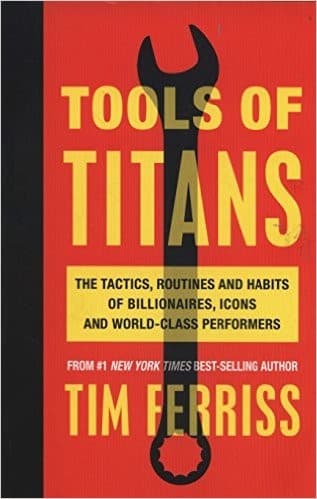
Book details and cover from Google Books.
Ready to read Tools of Titans?
Get your copy on Amazon, or listen to it on Audible. We earn a commission if you buy through these links.