
We earn a commission if you buy through these links. Learn more
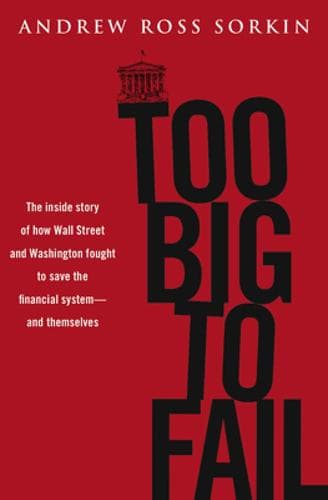
Too Big to Fail
A reporter-built, minute-by-minute account of the 2008 weekend deals and collapses that nearly broke the financial system, told from inside the rooms where decisions were made.
What It's About
Too Big to Fail is Andrew Ross Sorkin's account of the 2008 financial crisis, built from many interviews with the bankers, regulators and government officials who were in the room when the system nearly came apart. Sorkin, a New York Times reporter who covered Wall Street's deal-making, focuses on a compressed stretch of months in which Bear Stearns was sold, Lehman Brothers was allowed to fail, and the government moved to rescue insurers and banks it had not planned to save.
The approach is narrative journalism. Sorkin moves between boardrooms, Treasury offices and the Federal Reserve, often tracking events hour by hour and sometimes over a single weekend, so the reader feels the pressure of decisions made with incomplete information. The cast is large, and the book leans on dialogue reconstructed from sources, which gives it momentum but means you are reading one carefully assembled version of events rather than a transcript.
The experience is closer to a thriller about institutions than a policy textbook. You get a strong sense of who was pushing for what and why people feared a cascade of failures, and less of the slow buildup of mortgage lending and regulatory gaps that produced the crisis in the first place. Expect to keep a mental scorecard of firms and officials.
Read this if you…
- want a detailed, human-level account of how the 2008 crisis unfolded inside firms and government offices
- followed the financial news in 2008 and want the scenes you missed
- enjoy business narratives that read with the momentum of a thriller
Skip it if you…
- want the causes of the crisis explained from the ground up, starting with the mortgage market
- prefer analysis of inequality, regulation and accountability over insider drama
Key Ideas
- 1
Crisis decisions were made under extreme time pressure
Sorkin shows how much of the outcome turned on deadlines, such as markets opening on Monday, and on how little time officials had to judge which firms were solvent, which were merely short of cash, and what a collapse would set off elsewhere.
- 2
The line between rescue and abandonment looked arbitrary
The book argues that choices about which firms to save, such as Bear Stearns compared with Lehman Brothers, were shaped by legal limits, politics and personalities as much as by financial logic, which is why the decisions looked inconsistent to outsiders.
- 3
Confidence mattered as much as capital
Sorkin describes how fear that a firm's trading partners would not get paid spread through short-term funding markets, so trouble at one institution could freeze others that looked healthy on paper. Trust, in other words, was a financial asset that could vanish overnight.
- 4
Relationships and personal judgment steered events
Much of the narrative centers on figures such as the Treasury secretary, the Fed chairman, and the heads of major banks. Sorkin suggests that long-standing relationships and gut calls under stress carried real weight in choices that affected the whole economy.
Limitations
Critics have argued the book sees the crisis mainly from the vantage of Wall Street executives and Washington officials, so ordinary borrowers, workers and communities appear mostly at the margins. Its reliance on interviews means participants' self-interest shapes many scenes, and readers should treat motives and dialogue as reported rather than independently verified. Because it was written close to the events, later research on lending practices and regulation has added context the book does not fully supply.
Questions Readers Ask
- Do I need a finance background to follow it?
- No. Sorkin explains terms such as repo funding, credit default swaps and capital ratios as they come up, and the story is driven by people and deadlines. The large cast of executives and officials can be hard to track, so a list of names or a simple timeline helps. A basic sense of how banks borrow and lend makes the stakes clearer.
- How does it compare with other books on the crisis?
- Michael Lewis's The Big Short focuses on a few investors who bet against mortgage debt and has a more irreverent tone. Too Big to Fail covers the emergency response from inside the rescue effort, so it suits readers who want the policy decisions of 2008 and 2009 rather than the origins of the mortgage bubble.
- Is it still worth reading?
- Yes, if you want the events of 2008 and 2009 reconstructed in detail. Debates about bailouts, moral hazard and regulation remain active, and the book helps you see how the decisions were actually made. Pair it with a later analysis of the causes for a fuller picture.
- Published
- 2009
- ISBN
- 9780141931777
- Difficulty
- intermediate
- Category
- Business
Book details and cover from Google Books.
Ready to read Too Big to Fail?
Get your copy on Amazon, or listen to it on Audible. We earn a commission if you buy through these links.