
We earn a commission if you buy through these links. Learn more
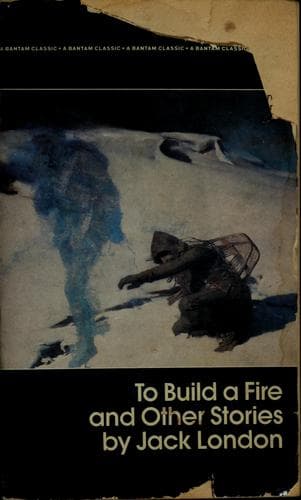
To Build a Fire and other stories
by Jack London
Guide by the Books of the Day editors · Updated · How we write our guides
Lean, cold-weather fiction from the Yukon gold rush, where nature is the real antagonist and the prose moves fast. A sharp entry point into London's short work.
What It's About
Jack London's stories are mostly set in the Yukon and Alaska during the gold rush era, where the cold, the distance, and the land's indifference do much of the work. The title story, about a newcomer who underestimates the temperature and tries to make a fire in the subarctic, is the best-known piece and a good test of whether this style suits you. A collection like this gathers his shorter fiction so you can sample his range without committing to a novel.
The prose is lean and physical. London writes in short, declarative sentences, lingers on tools, animals, weather, and bodily sensation, and rarely stops to explain what characters feel. Dogs appear often and are drawn with real attention, sometimes more vividly than the people. Characters tend to be defined by how they behave under pressure rather than by backstory, and many stories are built around a single crisis that moves quickly.
Reading these is an experience of tension more than comfort. You feel the cold in your hands and the arithmetic of rations and distance. Some stories carry the racial and social attitudes of their time, which can jar today, and the emotional register is often stern and masculine. The pleasure lies in the momentum and the precision of the physical detail.
Read this if you…
- want tense, fast-paced survival stories with little filler
- enjoy spare prose that trusts concrete detail over psychological explanation
- are curious about early twentieth-century American adventure writing and its nature themes
Skip it if you…
- need complex interiority, subtle relationships, or ambiguous moral characters
- are likely to be put off by dated racial attitudes and a stern, masculine worldview
Key Ideas
- 1
Nature as an indifferent force
In London's northern stories the environment is not a backdrop but the central opponent. It does not care about courage or good intentions, and characters are measured by how accurately they read temperature, terrain, and weather. The threat is rarely dramatic in a conventional sense; it accumulates through small errors and ordinary conditions that become lethal.
- 2
Survival as a test of judgment
Many of the stories turn on the gap between what a character knows and how confident he feels. Overconfidence, poor planning, and stubborn pride are the recurring failures. London is interested in the moment when a person's habits and assumptions meet a situation they cannot bend, and in how little margin for error exists.
- 3
The animal beneath civilization
Dogs and wild animals serve as mirrors for human behavior. London's fascination with instinct, competition, and what lies underneath social manners reflects the evolutionary ideas popular in his time. Readers who enjoy this theme will find the stories more rewarding than those who expect a straightforward moral lesson.
- 4
A spare style built on physical detail
London's craft is the main reason to read him. He handles sensory detail with economy, letting a few concrete images carry dread or exhaustion. The short sentences and tight focus create momentum, and the stories often feel more immediate than their age would suggest.
Limitations
The stories often share a narrow frame: white men testing themselves against the wilderness, with women and non-white characters appearing little or in stereotyped roles. Some readers find the nature-as-destiny philosophy heavy-handed, and the emotional range is limited compared with later writers. Contents also vary between editions, so check the table of contents before buying if a specific story matters to you. The sheer repetition of the survival format can wear thin over a full collection.
Questions Readers Ask
- Is To Build a Fire still worth reading today?
- Yes, especially as a short, gripping example of how to build tension with minimal means. The story remains widely taught because its structure is so efficient. Its attitudes toward the man at its center and the natural world reflect early twentieth-century thinking, so it rewards reading with a critical eye as well as for pleasure.
- How does this compare with Jack London's novel The Call of the Wild?
- The novel follows a dog's journey and has a broader, more sentimental arc, while these stories are tighter, harsher, and more focused on human error and endurance. If you liked London's animal writing, the novel is a good next step. If you want concentrated tension, start with the short stories.
- Published
- 1986
- ISBN
- 9780553212136
- Difficulty
- beginner
- Category
- Fiction
Book details and cover from Google Books.
Ready to read To Build a Fire and other stories?
Get your copy on Amazon, or listen to it on Audible. We earn a commission if you buy through these links.