
We earn a commission if you buy through these links. Learn more
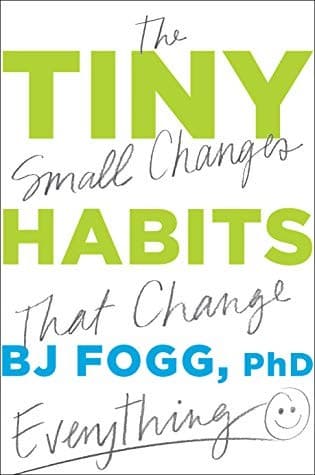
Tiny Habits
by B. J. Fogg
Guide by the Books of the Day editors · Updated · How we write our guides
Fogg's Tiny Habits is a practical, short guide to building routines by starting absurdly small, attaching new actions to existing ones, and rewarding yourself immediately, so change doesn't depend on willpower.
What Creators Say About Tiny Habits
2 creators reviewed Tiny Habits on YouTube in 2020, with 161.9K views between them. Their opinions are their own; we picked these reviews, we didn't write them.
What It's About
Tiny Habits is written by B. J. Fogg, a Stanford behavior scientist who runs a behavior design lab. Rather than offering a grand theory of self-improvement, he gives a compact model of why people do things and a method for making new behaviors stick. The core claim is that behavior happens when motivation, ability, and a prompt come together at the same moment, and that most failed resolutions are really failures of ability: the goal was too big to do on an ordinary day.
The book's approach is deliberately simple. You pick a behavior so small it feels almost silly, such as doing one push-up or flossing a single tooth, then link it to a moment that already happens in your day. You then celebrate the instant you do it, because Fogg argues that the positive feeling is what wires the habit in. Growth comes later, once the routine is automatic and you can make the behavior a little bigger.
Reading it feels more like working through a workshop than absorbing a theory. The chapters are short, the examples are personal and concrete, and there are plenty of prompts to try things on your own life. It rewards readers who are willing to experiment for a week or two, and it can feel thin if you are looking for deep psychological research or long case studies.
Read this if you…
- want a concrete method for building small routines without relying on willpower
- have tried and abandoned big resolutions and suspect the goals were too ambitious
- like short, practical books that ask you to test ideas in your own daily life
Skip it if you…
- are looking for dense research, detailed studies, or a scholarly account of habit science
- expect a long, narrative book with extended stories and a strong authorial voice
Key Ideas
- 1
Behavior happens when motivation, ability, and prompt align
Fogg's behavior model says a behavior occurs only when three things converge: enough motivation, enough ability to do it, and a prompt that triggers it. When a habit fails, he suggests checking which of these is missing. In most everyday cases, the fix is to make the behavior easier rather than to find more drive, which is why he keeps returning to ability as the lever you can actually control.
- 2
Start with a behavior so small it is hard to fail
The method asks you to shrink the target action until it takes almost no effort, even if the result looks trivial. The point is not the size of the win but the repetition. Once a tiny action happens reliably, it creates a foundation you can expand. This reframes failure: missing a day becomes information about the design, not a verdict on your character.
- 3
Anchor new habits to moments you already have
Instead of relying on reminders or a fresh decision each time, Fogg recommends attaching the new action to an existing routine, such as something you do after brushing your teeth or after sitting down at your desk. The existing habit serves as the prompt, so the new one gets triggered without much thought. Choosing a clear, consistent anchor matters more than choosing a clever one.
- 4
Celebrate immediately to make the habit feel good
Fogg argues that emotion, specifically a small burst of positive feeling right after the behavior, is what drives repetition. He encourages you to pick a celebration you genuinely enjoy and use it the instant the tiny habit is done. The celebration is not a bribe for a large result but a signal that the action succeeded, which gradually makes the habit feel rewarding rather than like a chore.
Limitations
The book leans heavily on Fogg's own experience and on examples from his teaching, so readers looking for broad research synthesis or independent evidence may find it thin. Its advice works best for habits that are easy to start and easy to anchor; harder problems such as addiction, deep anxiety, or entrenched compulsions need more than a tiny-step approach. Some readers also find the upbeat celebration framing a bit formulaic, and the core method can feel more repetitive than its length would suggest.
Questions Readers Ask
- Who is Tiny Habits best suited for?
- It suits people who want a practical starting point for changing routines and who are comfortable experimenting. If you are new to habit change, the method is easy to grasp and quick to try. Readers who already know a lot about behavior science may find the ideas familiar, though the specific anchoring and celebration techniques are still useful.
- How does it compare to Atomic Habits?
- Both focus on small changes, but Tiny Habits is shorter and more of a single method, centered on the behavior model and a few steps. Atomic Habits by James Clear covers more ground, with more stories and a broader framework for identity and environment. Choose Tiny Habits if you want something quick and specific, and Clear's book if you want a fuller tour.
- Published
- 2019
- ISBN
- 9781713508212
- Difficulty
- beginner
- Category
- Psychology
Book details and cover from Google Books.
Ready to read Tiny Habits?
Get your copy on Amazon, or listen to it on Audible. We earn a commission if you buy through these links.