
We earn a commission if you buy through these links. Learn more
Through the language glass
A linguist's sharp, witty tour of the claim that the language you speak shapes how you see the world, testing it against color, space, and gender with unusual honesty.
What It's About
Through the Language Glass takes on an old and tempting idea: that the grammar and vocabulary of your mother tongue quietly steer how you perceive and reason. Deutscher begins with the Sapir-Whorf hypothesis, whose strong form has been popular for much of the last century and which he regards with suspicion. He then asks a narrower and more answerable question: does language shape thought in ways we can actually observe and measure?
His method is historical and comparative. Rather than relying on laboratory findings alone, he traces how languages change over time, how color words accumulate, and how spatial systems differ between cultures. He draws on older texts and on communities whose languages handle everyday concepts in ways English never bothers with. The tone is conversational and playful, with ironic asides and a willingness to admit when a famous claim looks overstated.
Reading it feels less like absorbing a fixed theory and more like watching an argument get refined. You finish with a sharper sense of which linguistic differences plausibly matter for everyday thought and which are mostly curiosities. It rewards readers who enjoy following evidence, and it does not pretend the question is settled.
Read this if you…
- are curious how language and perception interact but want evidence rather than slogans
- enjoy seeing a famous idea tested with history and examples from many languages
- want a witty, accessible read on linguistics for a general audience
Skip it if you…
- want a rigorous academic treatment with full methodological detail
- are looking for a practical guide to learning a second language
Key Ideas
- 1
The strong version of linguistic relativity is shaky
Deutscher separates the strong claim that language determines what we are able to think from weaker claims that it nudges our habitual attention. He argues the former collapses under the weight of counterexamples, while the weaker version survives and is far more interesting. Much of the book is an exercise in telling these two claims apart.
- 2
Color words grow over time, not all at once
He revisits the nineteenth-century observation that ancient Greek texts seem to lack a clear word for blue, and treats it as a question about how vocabulary develops. Color terms tend to appear in a fairly predictable order across languages. Missing words, he suggests, often reflect cultural priorities rather than an inability to perceive the color.
- 3
Absolute direction and how languages map space
Some communities describe locations with fixed compass directions rather than left and right, which forces speakers to keep track of orientation constantly. Deutscher asks what this changes about spatial memory and attention. His answer is that such habits can be studied, but their effects seem to lie in how people describe and remember places more than in what they can perceive.
- 4
Grammatical gender and the problem of evidence
He examines the claim that a language's gender for nouns such as bridge or key shifts how speakers describe those objects. Along the way he shows how to scrutinize psychology experiments, asking about design, interpretation, and whether results generalize. The chapter is valuable as a lesson in judging any claim about language and mind.
Limitations
Some readers find the book's cheerful skepticism too quick to dismiss research that later studies have partly supported, and the debate has moved on since its 2010 publication. Its examples lean on a handful of well-studied languages and communities, so it is more a critical essay than a survey of the field. Readers wanting the latest experimental results will need to look further afield.
Questions Readers Ask
- Is this book only for linguists?
- No. It is written for general readers and explains technical terms as it goes. Some chapters require following arguments about evidence, but no prior background in linguistics is needed. Readers who enjoy popular science and the history of ideas will find it accessible and engaging.
- Is it still relevant to the debate about language and thought?
- Yes, as a clear entry point. Research on color perception and language effects has continued since 2010, so check newer studies for current findings. Deutscher's distinction between strong and weak claims remains a useful framework for judging new claims about how language shapes thinking.
- How does it compare to Pinker's The Language Instinct?
- Pinker's book is broader, covering how children acquire language and how the mind builds it. Deutscher's book is narrower and focuses on the specific claim that language shapes thought, with more attention to history and to how languages change over time. The two complement each other well.
- Published
- 2010
- ISBN
- 9780805081954
- Difficulty
- beginner
- Category
- History
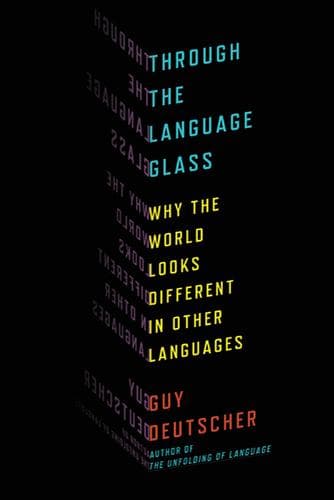
Book details and cover from Google Books.
Ready to read Through the language glass?
Get your copy on Amazon, or listen to it on Audible. We earn a commission if you buy through these links.