
We earn a commission if you buy through these links. Learn more
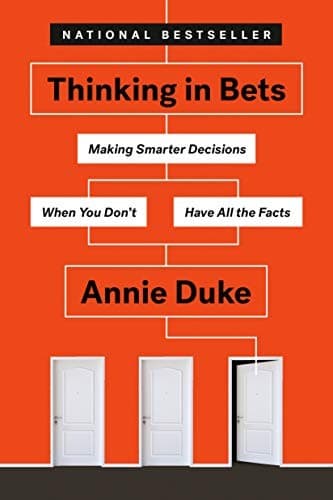
Thinking in Bets
by Annie Duke
Guide by the Books of the Day editors · Updated · How we write our guides
Annie Duke uses lessons from professional poker to show why good decisions can still lose and bad ones can still win, and how to think about uncertainty more clearly.
What Creators Say About Thinking in Bets
2 creators reviewed Thinking in Bets on YouTube between 2020 and 2024, with 263.9K views between them. Their opinions are their own; we picked these reviews, we didn't write them.
What It's About
Thinking in Bets is a book about decision-making under uncertainty, written by a former professional poker player who later became a decision strategist. Its central move is to treat life as a series of bets: every choice is made with incomplete information, so the outcome tells you only part of the story about how good the choice was. Duke spends most of her time on the habits that follow from that idea, such as separating luck from skill, asking how confident you really are, and building routines that catch your own errors before they cost you.
The style is conversational and anecdote-driven. Poker hands, sports, business decisions, and everyday dilemmas are used as examples, and the reader is nudged to notice the same patterns in their own life. Some chapters offer concrete exercises, such as imagining a plan has failed and working backward to see why, while others are more about shifting the mindset you bring to a disagreement or a setback.
Reading it feels less like studying a theory and more like listening to a sharp, practical mentor explain how she learned to stop tying her self-worth to every result. It is short enough to finish in a few sittings, and the ideas are easy to apply right away, though the best payoff comes if you actually try the habits rather than just nodding along.
Read this if you…
- want a practical framework for making decisions when the outcome is uncertain
- work in business, management, or any role where you make calls with incomplete information
- want a more forgiving but honest way to review your own mistakes
Skip it if you…
- are looking for deep original research, since the book leans on established findings and personal stories
- want a rigorous, quantitative treatment of probability and decision theory
Key Ideas
- 1
Outcomes are poor judges of decisions
Duke argues that people routinely judge a choice by how it turned out rather than by the quality of the reasoning behind it. A sound decision can produce a bad result through bad luck, and a reckless one can succeed. Learning to separate the two is the foundation for the rest of the book and is useful well beyond poker.
- 2
Think in probabilities, not certainties
Rather than asking whether you were right or wrong, Duke encourages you to estimate how likely different outcomes are and how confident you are in your estimate. This habit makes it easier to update your views when new information arrives, instead of defending a position because you have already committed to it.
- 3
Self-serving bias distorts how we learn
The book examines how people credit good outcomes to their own skill and blame bad ones on chance or other people. Over time this makes it hard to learn from experience. Duke suggests practical ways to review decisions more honestly, including asking how the same situation would look if the outcome had gone the other way.
- 4
Build groups that challenge your thinking
Duke makes the case for surrounding yourself with people who will question your conclusions and reward accuracy rather than agreement. She describes how a group that values honest disagreement can help individuals and teams avoid comfortable but mistaken beliefs.
- 5
Pre-mortems and commitment devices
Two tools stand out: imagining in advance that a plan has failed and asking why, and setting rules for yourself before emotions run high so you are less likely to make a bad call under pressure. Both are meant to be used routinely, not just in crisis.
Limitations
Critics often say the book is lighter on new research than its framing suggests, and that many of its core ideas, such as the premortem and the limits of hindsight, come from earlier psychology and decision science. The poker analogies are vivid but can oversimplify situations where outcomes are hard to separate from skill, or where emotional and moral stakes matter more than probabilities. Some readers find the advice more inspirational than specific, with fewer detailed methods for measuring your own accuracy over time.
Questions Readers Ask
- Do I need to know poker to understand Thinking in Bets?
- No. Poker is used as a teaching tool, and the book explains any terms it needs. The examples range from poker and sports to business and personal choices, so the ideas stand on their own. Some readers find the poker stories the most engaging part, but you do not need any background to follow the argument.
- How does it compare to Thinking, Fast and Slow?
- Kahneman's book is denser, more research-heavy, and more academic in tone. Duke's is shorter, more personal, and focused on practical habits you can apply to everyday decisions. If you want the scientific foundation, Kahneman goes deeper. If you want to change how you approach choices and reviews, Duke is often the more immediately useful read.
- Published
- 2018
- ISBN
- 9786052314142
- Difficulty
- beginner
- Category
- Business
Book details and cover from Google Books.
Ready to read Thinking in Bets?
Get your copy on Amazon, or listen to it on Audible. We earn a commission if you buy through these links.