
We earn a commission if you buy through these links. Learn more
Things Fall Apart
Guide by the Books of the Day editors · Updated · How we write our guides
A short, tightly controlled novel that shows an Igbo community from the inside before colonial change arrives, making it one of the most important books in modern African literature.
What Creators Say About Things Fall Apart
2 creators reviewed Things Fall Apart on YouTube between 2014 and 2020, with 1.6M views between them. Their opinions are their own; we picked these reviews, we didn't write them.
What It's About
Things Fall Apart follows Okonkwo, a respected man in a late nineteenth-century Igbo village whose standing rests on hard work, wrestling strength, and a deep fear of being seen as weak, like his father before him. The early chapters let you settle into his world: its councils, ceremonies, farming seasons, and moral logic. Nothing is explained to an outsider, so its customs feel coherent long before they start to look contested.
Achebe writes in plain, rhythmic English that carries the cadence of Igbo speech and frequent proverbs, so the prose feels translated from another language. The narration stays close to the community's own perspective rather than standing above it, which makes the later shifts hit harder. As the clan is drawn into a larger colonial order, the book's focus widens, and the reader is asked to hold two systems of meaning in mind at once.
Reading it is less a page-turner than a steady, sorrowful build. It is short enough to finish in a few sittings, but it rewards slow reading and a second pass. Expect many named characters and proverbs that may feel dense at first; they become the texture of the book.
Read this if you…
- want a foundational work of world literature that changes how you read colonial history
- are curious how a society's own values can produce both stability and tragedy
- enjoy short novels with a strong central character and a slow, weighty build
Skip it if you…
- need fast plot momentum or a twisty mystery
- want a neutral history of colonial Nigeria, since this is a novel with a clear point of view
Key Ideas
- 1
Pride and fear as a personal trap
Okonkwo's central drive is a fear of appearing like his father, a man remembered for debt and idleness. That fear shapes his choices, his temper, and his relationships with his family. The novel shows how a value system can reward a person and also make him brittle, so his strengths and his failures grow from the same root.
- 2
A functioning society seen from within
Achebe gives the Igbo world its own institutions, justice, religion, and gender roles, and he does not present them as idyllic. Councils, titles, and rituals have real authority and real blind spots. The book's achievement is to make this society complex and self-governing, so later disruption is understood as a loss of something real.
- 3
Two systems colliding
The arrival of missionaries and colonial administrators is depicted as gradual and uneven, carried by individuals and institutions rather than a single dramatic event. Some villagers respond with curiosity, others with resistance. The novel explores how external power finds purchase inside an existing community, a process that is slower and more ambiguous than simple conquest.
- 4
Storytelling as a counter-narrative
Achebe's stated aim was to correct the way Africa had been portrayed in European writing. He does this formally, by using English shaped by Igbo idiom and by telling the story from inside the culture. Readers who know colonial literature will notice how the book answers older accounts by letting its subjects speak for their own world.
Limitations
Some readers find Okonkwo's rigid, violent masculinity hard to sympathize with, and the novel's treatment of women and of outcast groups is often criticized as limited by its own worldview. The colonial characters are seen mainly from outside, so their motives remain thinner than the village's. The book covers one community in one period and does not claim to represent Nigeria or Africa as a whole. Its pacing in the final stretch also divides readers.
Questions Readers Ask
- Is Things Fall Apart still relevant today?
- Yes. It is widely taught because it deals with cultural change, religious conflict, and the costs of colonial rule, which remain active questions. It is also a model for how literature can answer earlier writing about a region. Its concerns about identity and community feel current in many places beyond Nigeria.
- How does it compare to Heart of Darkness?
- Both novels address European encounters with Africa, but they face in opposite directions. Conrad's novella is told from a European vantage point. Achebe later criticized it directly, and Things Fall Apart is his response, centered on the African community rather than the European visitor.
- Published
- 1958
- ISBN
- 9780679417149
- Difficulty
- beginner
- Category
- Fiction
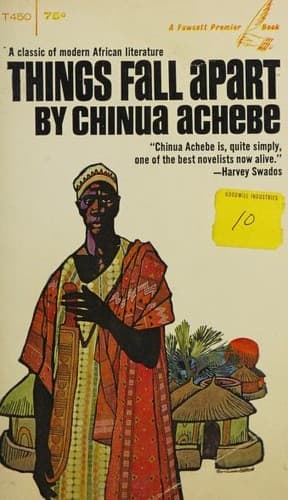
Book details and cover from Google Books.
Ready to read Things Fall Apart?
Get your copy on Amazon, or listen to it on Audible. We earn a commission if you buy through these links.