
We earn a commission if you buy through these links. Learn more
Thing Explainer
A playful, clever book that explains rockets, reactors, and other complicated machines with hand-drawn diagrams labeled using only the thousand most common English words.
What It's About
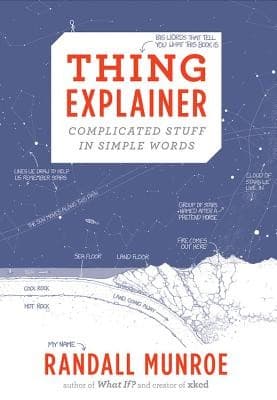
Thing Explainer (2015) is Randall Munroe's follow-up to his xkcd comics. It is a collection of detailed, hand-drawn diagrams of machines and systems, including rockets, nuclear power plants, and particle accelerators. Each picture is labeled and described using only the thousand most common English words. That restriction is the joke and also the method.
The experience is closer to flipping through a sketchbook than reading a textbook. Each page pairs a drawing with short captions that do most of the explaining. You can read a page in a minute or linger over the labels, and the small jokes hidden in the drawings reward slow looking. Because Munroe cannot use technical names, he has to describe each thing by its parts and what they do, which makes the sentences surprisingly clear about how the machinery works.
It is not a complete reference, and it does not try to teach physics or engineering in depth. What you get is a sense of how a wide range of modern objects fit together, and a demonstration that jargon often hides more than it reveals. Think of it as a light, funny tour that leaves you curious enough to look things up yourself.
Read this if you…
- are curious about how everyday or large-scale machines work but find textbooks off-putting
- enjoy xkcd-style humor and want a book you can dip into for a few minutes at a time
- want to see how much clearer writing can get when you strip away jargon
Skip it if you…
- need detailed technical knowledge or equations for a course or job
- expect a continuous narrative or a book you finish in one sitting with a clear argument
Key Ideas
- 1
Constraints can sharpen explanation
By allowing only the thousand most common words, Munroe forces every description to rest on function and structure rather than specialist vocabulary. The result is a lesson in how much technical language can hide, and how a plain sentence can still be precise about how something works.
- 2
Drawings do real explanatory work
The illustrations are not decoration. Labels, arrows, and layouts show how parts connect and depend on one another. Many readers find the pictures communicate a machine's logic faster than a paragraph of prose would.
- 3
Complexity is made of simple parts
A recurring theme is that enormous systems, from power plants to launch vehicles, are assemblies of ordinary pieces doing understandable jobs. Seeing that structure can make intimidating technology feel more approachable without making it trivial.
- 4
Humor keeps the reader engaged
Munroe's dry asides and visual jokes give the book its personality. The humor is part of the teaching, since it keeps the reader looking closely at details that would otherwise be skipped.
Limitations
The book is a delight, but it is shallow by design. Each topic gets a page or two, so anyone wanting the physics, history, or engineering behind a machine will need other sources. Some readers find the self-imposed rule gimmicky after a while, and the vocabulary limit can make descriptions wordy or roundabout. It is also a picture book, so the reading experience depends heavily on whether you enjoy the drawings. Its coverage reflects Munroe's interests, so many common technologies are absent.
Questions Readers Ask
- Who is Thing Explainer best for?
- It suits anyone curious about how big or complicated things work, including teenagers, adults returning to science, and people who enjoy xkcd. You do not need a science background. It works well as a gift or a coffee-table book, and it is easy to read in short bursts.
- Is it a good way to learn real science?
- It is a good starting point rather than a full course. It gives you a feel for how systems are organized and sparks questions you can follow up with proper references. For depth, pair it with a more rigorous science book on the topics that interest you most.
- How does it compare to Munroe's What If?
- What If? answers odd hypothetical questions with long, researched explanations and is text-heavy. Thing Explainer is shorter, more visual, and built around diagrams and a single writing constraint. If you want substance and argument, start with What If?; if you want something light and illustrated, start here.
- Published
- 2015
- ISBN
- 9781473620926
- Difficulty
- beginner
- Category
- Science
Book details and cover from Google Books.
Ready to read Thing Explainer?
Get your copy on Amazon, or listen to it on Audible. We earn a commission if you buy through these links.