
We earn a commission if you buy through these links. Learn more
Their Eyes Were Watching God
Guide by the Books of the Day editors · Updated · How we write our guides
Hurston's 1937 novel turns one woman's search for her own voice into a lush, funny, and sharp portrait of love and community in a Black Florida town.
What Creators Say About Their Eyes Were Watching God
2 creators reviewed Their Eyes Were Watching God on YouTube between 2016 and 2022, with 910.3K views between them. Their opinions are their own; we picked these reviews, we didn't write them.
What It's About
Their Eyes Were Watching God follows Janie Crawford, a Black woman living in a small all-Black town in Florida. The story is framed as a return: Janie comes home after a long absence, and her friend Pheoby sits with her while she tells the story of her life. That retrospective structure lets Hurston move between a close, personal inner voice and the talk of the town's porch, where neighbors gossip, joke, and pass judgment.
Hurston writes in a free indirect style, so Janie's thoughts and the narrator's voice blur together. The sentences are often lyrical, full of imagery of blossoming trees, horizons, and weather. Much of the dialogue is rendered in the dialect of rural Black Southerners, which takes a little getting used to. Hurston trained as an anthropologist and folklorist, and that interest shows up in the tall tales, sermons, and street humor that make the community feel alive.
Reading it feels less like following a plot than like being let into a conversation that has been going on for years. The novel is short and moves through marriages, relocations, and a long stretch in the Everglades, but its real attention is on what Janie wants, what she is permitted to want, and how she explains herself to people who think they already know her story.
Read this if you…
- want a novel where the voice and the language are the main point
- are interested in how Black women's inner lives were written about in the 1930s
- enjoy slow, talky books about love, reputation, and self-definition
Skip it if you…
- need a fast-moving plot or a clear moral lesson
- find heavy dialect dialogue tiring and want a more standard prose style
Key Ideas
- 1
Voice as the book's central engine
Hurston's narration keeps Janie's inner judgments close at hand while the town's voices push back against them. The tension between how Janie sees herself and how others describe her is the engine of nearly every scene, and the book rewards readers who pay attention to who is speaking and who is being talked about.
- 2
Womanhood shaped by others and by Janie
Janie is pressured from childhood by her grandmother's hope for her security, then by husbands who want to own her image as much as her labor. The novel asks what it means to be seen by others versus to define yourself, and it treats that question with more complexity than a simple story of escape.
- 3
Love as a question of equality
Romantic longing in the book is never just about passion. Janie keeps testing whether a partner will let her speak and act as a full person. The book treats desire, companionship, and autonomy as connected, and it does not offer a tidy answer about how they fit together.
- 4
Community as chorus, not backdrop
The porch-sitting townspeople function almost like a Greek chorus, commenting, mocking, and remembering. Their gossip shapes Janie's reputation and the reader's sense of her. Hurston uses folk humor and vernacular storytelling to show that a community's way of talking is part of how its members are formed.
Limitations
Richard Wright, reviewing the novel when it appeared in 1937, faulted it for not confronting racism and social injustice directly. Some modern readers find its focus on the intimate and personal narrow, since segregation and economic hardship sit mostly in the background. Tea Cake's jealousy and violence also trouble many readers, and the book's romantic idealism can feel uneven. The dialect, while central to its texture, can slow down readers unfamiliar with it.
Questions Readers Ask
- Is Their Eyes Were Watching God still worth reading today?
- Yes. It has become a standard in American literature courses, and it was an important influence on later Black women writers. Its concerns about voice, reputation, and women's autonomy still feel current. Readers coming to it now should expect a 1930s setting and language, but the emotional and social questions it raises remain sharp.
- How does it compare to The Color Purple?
- Both novels center a Black woman's search for self-definition in the rural South and use vernacular speech. Alice Walker has acknowledged Hurston's influence, and readers often find the two linked. Hurston's book is more lyrical and more concerned with community talk, while Walker's is more epistolary and more openly focused on violence and faith.
- Is the dialect hard to follow?
- Most readers adjust within a few chapters. The dialect is mostly in dialogue, and the narration is in more standard English, so the rhythm becomes familiar quickly. Reading a few pages aloud can help, since much of the speech is meant to be heard as well as read.
- Published
- 1937
- ISBN
- 9781983254246
- Difficulty
- intermediate
- Category
- Fiction
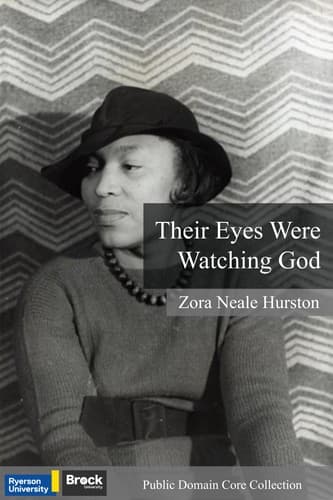
Book details and cover from Google Books.
Ready to read Their Eyes Were Watching God?
Get your copy on Amazon, or listen to it on Audible. We earn a commission if you buy through these links.