
We earn a commission if you buy through these links. Learn more
The worst hard time
by Timothy Egan
Guide by the Books of the Day editors · Updated · How we write our guides
A vivid, people-centered account of the 1930s Dust Bowl that shows how ecological damage and economic desperation combined to uproot families across the southern Plains.
What Creators Say About The worst hard time
1 creator reviewed The worst hard time on YouTube between 2011 and 2012, with 5.5K views between them. Their opinions are their own; we picked these reviews, we didn't write them.
What It's About
The Worst Hard Time is Timothy Egan's account of the American Dust Bowl, the drought and dust storms that scoured the southern Great Plains through much of the 1930s. He treats the disaster as both a natural event and a human one. Decades of plowing up grassland for wheat, followed by years without reliable rain, left the soil loose and exposed, and when the winds came, farms, towns, and lives were buried under dirt.
The method is narrative nonfiction. Egan moves between individual families who stayed on failing land, the towns that tried to hold together, and the broader currents of federal response and national indifference. Because of this, the storms feel like something people lived through rather than a statistic. The prose is vivid and often lyrical, with set-piece scenes of dust clouds rolling across the horizon, and the book reads quickly for its subject.
The experience is more emotional than analytical. You come away with a concrete sense of daily hardship, of the difference between those who stayed and those who loaded their belongings and headed west toward California, and of how the disaster reshaped American thinking about land, farming, and government help. It is a book that makes a hard chapter of history feel immediate and human.
Read this if you…
- want a human-scale account of a major American environmental disaster
- enjoy narrative history that reads almost like a novel without losing its factual grounding
- are curious about how ecological damage and economic hardship can feed each other
Skip it if you…
- want a detailed policy history of New Deal agricultural programs
- prefer dense academic analysis with extensive footnoted arguments over vivid storytelling
Key Ideas
- 1
Disaster built by people, not weather alone
Egan argues that drought was only part of the story. Aggressive plowing of the Plains during the high-price years of the early twentieth century stripped away the deep-rooted grasses that had held the soil in place. When dry years arrived, the land had little defense, and the book makes clear that the damage was a choice made by people chasing profit.
- 2
Ordinary families at the center
Rather than telling the story from the top down, Egan follows farmers, their wives and children, and small-town residents as they make impossible decisions. Their struggles over debt, failing crops, dust in their homes, and whether to leave give the abstract catastrophe a human scale that statistics alone could not provide.
- 3
The migration west and its costs
A large share of the book concerns those who abandoned the Plains for California and other places. Egan shows how the journey, the hostility many migrants met on arrival, and the loss of home and identity shaped the decade's social fabric, and why many of these stories still resonate with readers today.
- 4
Lessons about land and government
The book connects the 1930s crisis to later debates about conservation, agricultural policy, and the limits of individual enterprise. Egan does not offer a neat policy manual, but he shows how the emergency pushed Washington toward new kinds of involvement in farming, and how those responses were uneven and often came too late for many families.
Limitations
Some readers find the book more emotional than analytical, and the narrative weight on suffering can feel heavy across a long reading stretch. As a popular history, it covers the southern Plains and the migration story more fully than other regions or the detailed workings of federal policy. Scholars may want deeper engagement with historiographical debates, and some of the environmental explanations have been refined by later research. It remains a strong entry point rather than a final word.
Questions Readers Ask
- Is The Worst Hard Time still worth reading today?
- Yes. The book remains one of the most accessible introductions to the Dust Bowl, and its warnings about soil erosion, monoculture, and the consequences of boom-and-bust farming still feel relevant. Some specialist research has since added detail, but the human story and the core cause and effect it describes hold up well.
- Who is this book best suited for?
- It suits general readers who want a gripping history without a steep learning curve. It is also a good choice for students, anyone interested in American farming or the 1930s, and readers who enjoy narrative nonfiction in the vein of other popular histories of the American West and its hardships.
- Published
- 2005
- ISBN
- 9780547347776
- Difficulty
- beginner
- Category
- History
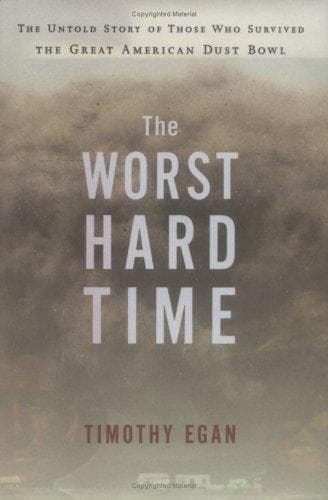
Book details and cover from Google Books.
Ready to read The worst hard time?
Get your copy on Amazon, or listen to it on Audible. We earn a commission if you buy through these links.