
We earn a commission if you buy through these links. Learn more
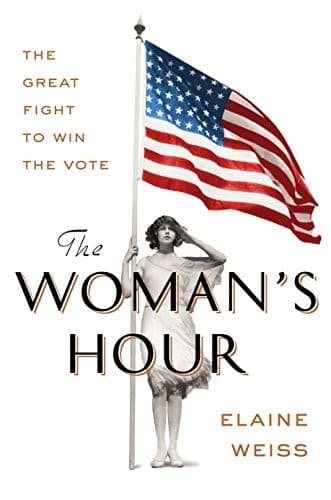
The Woman's Hour: The Great Fight to Win the Vote
by Elaine Weiss
A tense, character-driven account of the summer of 1920, when Tennessee's legislature decided whether women would win the vote nationwide.
What It's About
The Woman's Hour is a narrative history of the final stretch of the campaign for the Nineteenth Amendment. It centers on summer 1920 in Nashville, where Tennessee's legislature became the thirty-sixth state needed to ratify. Elaine Weiss builds the book around the people in the room and the corridors: suffrage organizers, anti-suffrage lobbyists, legislators pressed by their home districts, and the governor's office. Rather than surveying decades of activism, it compresses the story into one concentrated, high-stakes campaign.
The style is scene-driven, and the ticking clock is its engine. Weiss moves between factions and tracks vote counts, telegrams, and back-room bargaining, so the suspense comes from arithmetic as much as from speeches. She gives the major organizers distinct temperaments and shows their strategic disagreements, especially between the methodical leadership and the more confrontational wing. Readers who expect a strictly academic history may find the dialogue and interior perspective more novelistic than they would like.
The experience is fast and gripping, closer to a political thriller than a textbook. You come away with a vivid sense of how a constitutional change actually gets made: state by state, legislator by legislator, through persistence and some improbable luck. It works well as a first book on the subject and as a companion to longer scholarly accounts.
Read this if you…
- want a gripping, plot-driven introduction to how the 19th Amendment was ratified
- are interested in how political campaigns and legislative votes actually work
- enjoy narrative nonfiction that reads almost like a novel
Skip it if you…
- want a comprehensive history of the women's suffrage movement across the whole nineteenth and early twentieth centuries
- prefer history written in a detached, analytical voice with extensive scholarly apparatus
Key Ideas
- 1
Ratification as a matter of counting votes
Weiss shows that the amendment's fate hinged on a handful of state legislatures and on the exact count in each chamber. Ideals mattered, but so did timing, calendars, and which legislators could be moved. The book makes the mechanics of constitutional change feel concrete rather than abstract.
- 2
Two strategies in uneasy tension
The book contrasts a patient, coalition-building approach with a more militant, headline-seeking one. Both camps wanted the same result, yet they clashed over tactics and credit. Weiss treats these disagreements as real and consequential, not as a simple story of heroes and bystanders.
- 3
The opposition's fears and organization
Anti-suffrage forces were not caricatures. They were organized, well funded, and worried about federal power, states' rights, and changes to social roles. Understanding their arguments helps explain why the vote came down to such a narrow margin.
- 4
Personal conscience under political pressure
Legislators faced constituents, party leaders, and family, and their individual decisions carried enormous weight. The book uses these moments to show how a single vote can depend on private persuasion as much as public principle.
- 5
Who was left out of the victory
The book acknowledges that the amendment did not immediately enfranchise Black women, especially in the South, where Jim Crow restrictions remained. Readers looking for a fuller account of Black suffragists' role should expect that thread to be secondary to the Tennessee campaign.
Limitations
The book is tightly focused on the 1920 Tennessee campaign, so it does not trace the movement's earlier decades in depth. Its emphasis falls mainly on white suffrage leaders and the national organizations they led, which leaves less room for Black women's organizing and for the Southern Black women who were excluded from the vote long after ratification. Some critics also note that its reconstructed scenes and dialogue give a novelistic texture that a stricter historian might handle more cautiously. Readers wanting a broader or more critical account should pair it with other sources.
Questions Readers Ask
- Who is The Woman's Hour for?
- It suits readers who want an engaging, accessible story of how women won the vote and who enjoy political drama. No prior knowledge of suffrage history is needed. Readers who want deep analysis of the movement's ideas or the lives of Black suffragists may find it too narrow and will likely want to read more afterward.
- Is the book still relevant today?
- Yes. The questions it raises about how constitutional change happens, how minorities organize to win political fights, and how voting rights remain contested are still active. Its narrow timeframe does not make the lessons dated, though its treatment of race reflects an older focus that later scholarship has expanded.
- How does it compare to Ellen Carol DuBois's work on suffrage?
- DuBois's scholarship is more analytical and wider in scope, examining the movement's ideas and development over time. Weiss's book is shorter in focus and more dramatic in style. Many readers start with Weiss for the story and then turn to DuBois for context and argument.
- Published
- 2018
- ISBN
- 9780525429722
- Difficulty
- beginner
- Category
- History
Book details and cover from Google Books.
Ready to read The Woman's Hour: The Great Fight to Win the Vote?
Get your copy on Amazon, or listen to it on Audible. We earn a commission if you buy through these links.