
We earn a commission if you buy through these links. Learn more
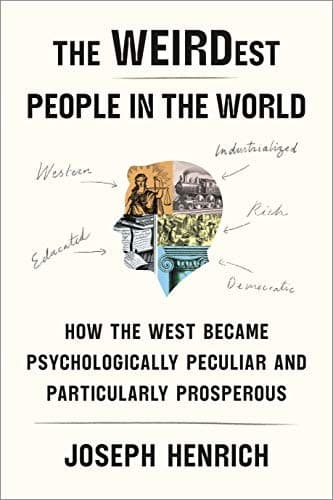
The WEIRDest People in the World
by Joseph Patrick Henrich, Joseph Henrich
Joseph Henrich argues that centuries of Western Church marriage rules quietly built the individualist, analytic mind, and explains why psychology's usual test subjects are unusual.
What It's About
The book's central move is to ask why people from a small slice of the world, mostly Western Europe and its offshoots, behave so differently on tests of reasoning, fairness, and self-concept. Henrich argues that much of psychology is built on samples drawn from these populations, so findings often get presented as universal human nature when they describe one unusual group.
To explain the difference, he builds a long historical argument. From the late Roman period onward, he contends, the Western Church's rules on marriage, adoption, and inheritance gradually weakened clans and extended family networks. In his telling, this pushed people toward individual identity, impersonal trust, and voluntary associations, and he connects those shifts to later institutions and economic growth. The method blends history, anthropology, cross-cultural experiments, and psychology.
Reading it feels like sitting through a long, discursive lecture by an enthusiastic scholar. Expect substantial setup before the payoff, repeated caveats, and detours through experiments and ethnography. It rewards patience and a willingness to examine how your own assumptions were formed, but it is not a quick read, and its big causal claims are argued more than proven.
Read this if you…
- are curious how culture shapes thinking and want a big-picture history of Western social change
- work with psychology research or read its findings and want to understand the sampling problem
- enjoy long, argument-driven nonfiction and don't mind digressions on the way to the main point
Skip it if you…
- want a practical self-help guide or concrete tips for changing your own habits
- need a tight, quickly argued book with little digression or repetition
Key Ideas
- 1
Most psychology studies sample an unusual population
Henrich's starting point is that a large share of published research in psychology and behavioral economics draws on university students and people from Western, industrialized societies. He argues that when researchers treat those results as descriptions of all humans, they mistake a local pattern for a general law. Much of the book is an effort to show how far this problem extends and why it matters for what we think we know about the mind.
- 2
Church marriage rules dismantled extended kinship
The historical core of the argument is that the Western Church's restrictions on cousin marriage, adoption, and polygyny, enforced over many centuries, broke up the large kin groups that organized social life elsewhere. Henrich presents this as an unplanned cultural process rather than a deliberate social engineering project. The idea is provocative because it links an institution usually discussed in theological terms to the everyday psychology of modern people.
- 3
Individualism and impersonal trust as cultural products
According to Henrich, when kin networks lose their grip, people must rely more on strangers, personal reputation, and shared rules. Over generations this, he argues, shapes a sense of self centered on personal choice and a willingness to trust and cooperate with people outside one's family. He treats these traits as learned cultural adaptations, which makes the book useful for thinking about where familiar values come from.
- 4
Analytic versus holistic ways of thinking
Henrich draws on cross-cultural experiments to show that people from different societies attend to objects and context in different ways, with Western participants often focusing on individual items and categories. He ties these habits of perception and reasoning back to the broader social changes in his historical account. The evidence is suggestive and some findings are contested, so it is worth reading the examples critically rather than accepting them as settled.
- 5
From kin groups to voluntary associations and markets
The final stretch of the argument connects the social changes to the rise of voluntary groups, impersonal markets, and eventually the conditions behind Western economic growth. Henrich suggests that people freed from obligations to extended family were more likely to join clubs, guilds, and institutions based on choice. Readers interested in economic history will find this the most ambitious and the most debated part of the book.
Limitations
Critics dispute the causal chain from Church marriage policy to later prosperity, arguing that the historical evidence is selective and that other factors such as geography, political institutions, and earlier Roman history get less weight than they deserve. The WEIRD label itself is sometimes seen as too broad, lumping very different societies together. The book is also long and repetitive in places, and some readers find that its most interesting claims are presented as more certain than the evidence allows.
Questions Readers Ask
- Is The WEIRDest People in the World still relevant to psychology?
- Yes. The critique that most psychology samples come from WEIRD populations is widely cited and has influenced how researchers discuss generalizability. The stronger historical claims about the Church and the origins of individualism remain debated among historians and social scientists, so the book is best read as a provocative argument rather than settled science.
- How does it compare to Thinking, Fast and Slow?
- Kahneman's book focuses on cognitive biases inside a single mind, using experiments to explain how fast and slow thinking work. Henrich's book is more concerned with how culture and history shape those mental habits across societies. If you want practical insight into your own decision-making, Kahneman is the easier starting point; if you want to know why people differ, Henrich goes further.
- Published
- 2020
- ISBN
- 9781713547389
- Difficulty
- intermediate
- Category
- Psychology
Book details and cover from Google Books.
Ready to read The WEIRDest People in the World?
Get your copy on Amazon, or listen to it on Audible. We earn a commission if you buy through these links.