
We earn a commission if you buy through these links. Learn more
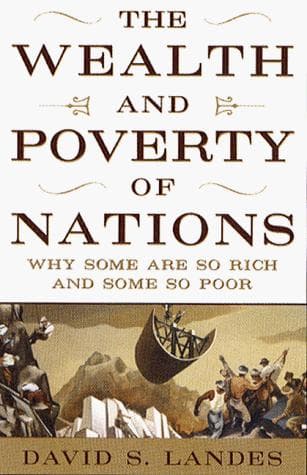
The wealth and poverty of nations
A sweeping, opinionated argument that culture, not just geography or resources, explains why some nations got rich and others stayed poor, told through centuries of vivid history.
What It's About
Landes sets out to answer one of economics' oldest questions: why did Western Europe, and later North America and parts of East Asia, pull so far ahead of most of the world? His answer leans hard on culture. He treats habits of mind, attitudes toward work, saving, time, curiosity and dissent as causes of prosperity rather than byproducts of it, and he is willing to say so bluntly. The book is less a single thesis tested with data than a long argument built from case studies, moving across Europe, China, the Islamic world, Japan, Africa and Latin America.
The approach is narrative and comparative. Landes draws on economic history, technology, religion and institutions to explain why some societies turned new inventions into lasting growth while others let them fade. Reading it feels like being walked through a great library by a guide who has strong views about nearly every shelf. Many passages are vivid and memorable, the anecdotes are often striking, and the tone is confident, sometimes combative, and frequently wry.
Expect a large, dense book with few concessions to a casual reader. Landes assumes you will follow long chains of cause and effect and keep track of many countries across many centuries. It rewards patience, and it will likely leave you arguing with it, which is part of its value.
Read this if you…
- want a big-picture history of why the modern world looks the way it does
- are curious about how culture and economics interact, and enjoy a strong argument
- like narrative history with vivid detail across many centuries and countries
Skip it if you…
- want a concise, data-driven analysis or the latest research on development
- prefer books that avoid sweeping generalizations about entire civilizations or cultures
Key Ideas
- 1
Culture shapes what societies do with knowledge
Landes argues that inventions alone do not produce wealth. What matters is whether a society values curiosity, tolerates dissent, and rewards effort and innovation. He points to places that had advanced technology but failed to turn it into sustained growth, and attributes much of the gap to attitudes and institutions shaping how people behaved.
- 2
Geography matters, but it is not destiny
Landes accepts that climate, disease and natural resources affect development, but he treats them as limits and opportunities rather than fixed outcomes. He notes that resource-rich regions can stagnate while resource-poor ones prosper, so the real question becomes how people respond to their surroundings.
- 3
Europe's edge came from political competition
Europe's division into rival states, cities and merchant communities meant innovators had somewhere to go when one ruler turned hostile. Landes sees this pluralism as a major source of the continent's advantage, and contrasts it with large centralized empires that could more easily suppress new ideas.
- 4
Time, precision and the discipline of work
Landes emphasizes attitudes toward time, punctuality, precision and the work ethic. He uses practical tools such as the mechanical clock to show how everyday technology both reflects and reinforces changing habits, and why those habits matter for economic life.
- 5
Why the wealth gap is hard to close
Landes is skeptical that aid and quick policy fixes can rapidly transform poor countries, because deeper habits and institutions change slowly. This part of his argument has earned him admirers and critics in roughly equal measure, and it shapes how he judges later development efforts.
Limitations
Landes's culture argument is the book's biggest target. Critics say it can slide into cultural stereotyping, that culture is hard to measure and is sometimes invoked to explain outcomes after the fact, and that the book underplays colonialism, slavery and the extractive institutions that shaped many poorer regions. Its tone can also feel dismissive toward non-Western societies. Because it appeared in 1998, it predates later work on institutions and the rise of China and other East Asian economies, so readers should pair it with more recent scholarship.
Questions Readers Ask
- Is it still relevant after more than two decades?
- Yes, for the questions it asks and the historical material it covers, but less so for some of its conclusions about specific countries. Its emphasis on culture remains debated, and the field has since leaned more on institutions, as in the work of Acemoglu, Johnson and Robinson. Read it as a major statement in an ongoing argument rather than the final word.
- How does it compare to Jared Diamond's Guns, Germs, and Steel?
- Both ask why Europe rose to dominance, but Diamond stresses geography, plants, animals and environment, while Landes puts human attitudes and institutions at the center. Landes is more opinionated and less willing to accept environmental explanations. If you read one, the other makes a useful counterweight.
- Published
- 1998
- ISBN
- 9780349111667
- Difficulty
- intermediate
- Category
- History
Book details and cover from Google Books.
Ready to read The wealth and poverty of nations?
Get your copy on Amazon, or listen to it on Audible. We earn a commission if you buy through these links.