
We earn a commission if you buy through these links. Learn more
The Way Things Work
A picture-led tour of how machines and everyday technology work, where David Macaulay's cutaway drawings let you see the hidden parts that make a lever, engine, or circuit do its job.
What It's About
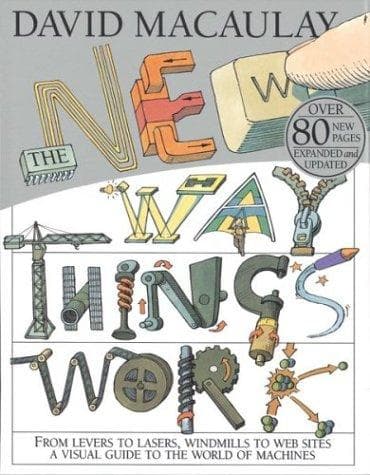
The Way Things Work is an illustrated guide to how machines and everyday technology operate, first published in 1988 and built around David Macaulay's densely detailed drawings. Rather than a textbook of equations, it is closer to a picture book for curious adults and older children. Each spread takes a device or principle and shows its parts, how they connect, and how force, motion, and energy move through them. The range runs from simple machines through engines, electricity, and communication to early computing.
The approach is cumulative. Macaulay relies on cutaway views, numbered callouts, and short captions in a dry, wry tone, so you follow the logic with your eyes as much as with the text. Many pages show a mechanism in action and then reveal what drives it. The pleasure lies in the layering: once you understand a lever or a gear train, later machines feel like combinations of ideas you already hold.
Reading it feels more like browsing a well-made museum catalogue than working through a course. You can open to almost any page and learn something concrete in ten minutes. It rewards slow looking and works best when you have time to stop and trace a drawing back to its first principles.
Read this if you…
- are curious about how everyday objects actually function and enjoy seeing the insides of things
- want a visual introduction to mechanics and energy before tackling more formal study
- are looking for a book to share with a teenager or child who likes taking things apart
Skip it if you…
- need precise, up-to-date coverage of modern electronics, software, or current technology
- want the mathematics behind engineering rather than an intuitive picture of how it works
Key Ideas
- 1
Simple machines as the building blocks
The book starts with the basic mechanical ideas, such as levers, pulleys, wheels, and gears, and treats them as the vocabulary for everything that follows. Its central claim is that complicated devices are arrangements of a small number of principles. Seeing that pattern repeat across different machines is the main lesson, and it makes later pages easier to follow.
- 2
Power sources and how they drive machines
A large share of the book is about where motion comes from. It shows how energy is captured, stored, and transferred, from muscle and falling water to steam and internal combustion. The focus is on the sequence of conversions inside a device, which is more useful for understanding than memorising specifications of any one engine.
- 3
Electricity, signals, and communication
The book moves from mechanical force into electrical systems, explaining how current can be switched, how signals travel, and how sound and messages can be carried over distance. The drawings make invisible processes concrete, though this section is necessarily simplified and works better as an introduction than a full course in electronics.
- 4
Seeing function through layered drawings
The distinctive idea is in the presentation itself: Macaulay uses precise cutaways and annotated sequences to show how parts relate in space and time. Readers learn to read a diagram as a story of cause and effect. This visual method is the book's real teaching tool and the reason it stays memorable long after the details fade.
Limitations
Because the book first appeared in 1988, its treatment of computing and electronics feels dated, and later editions have only partly closed that gap. Its explanations are deliberately simplified, so readers hoping for engineering depth, formulas, or design method will find it thin. Some reviewers also find the wry captions more decorative than informative. It is a strong starting point rather than a substitute for a proper textbook or hands-on experiments.
Questions Readers Ask
- Is The Way Things Work still worth reading today?
- Yes, for the mechanical and physical principles, which change very slowly. The drawings of levers, gears, engines, and basic electrical ideas still teach well. Expect the sections on modern electronics and computing to be out of date, and consider a newer companion or updated edition if you want current technology.
- Who is this book best suited to?
- It suits adults with no engineering background who want a clear picture of how machines work, and it is also popular with children and teenagers. Readers who already know the physics will find it a pleasant refresher, but they may want more depth than it offers.
- How does it compare with a typical visual encyclopedia?
- Where many visual encyclopedias offer quick reference entries across many subjects, this book goes deeper on a smaller set of ideas. Macaulay's cutaways and step-by-step sequences show how one mechanism leads to the next, so the reading is more of a connected explanation than a set of separate facts.
- Published
- 1988
- ISBN
- 9780395938478
- Difficulty
- beginner
- Category
- Tech
Book details and cover from Google Books.
Ready to read The Way Things Work?
Get your copy on Amazon, or listen to it on Audible. We earn a commission if you buy through these links.