
We earn a commission if you buy through these links. Learn more
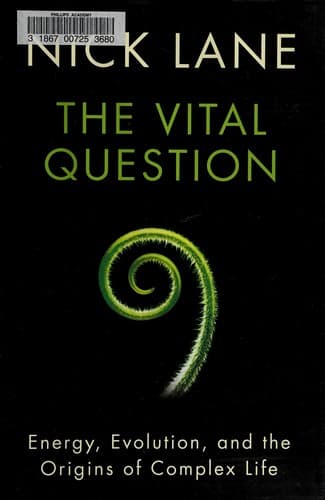
The vital question
by Nick Lane
Guide by the Books of the Day editors · Updated · How we write our guides
Nick Lane makes a convincing case that life's energy supply, not its genes, explains much of its strange shape, and the argument is bold enough to reward a careful reader.
What Creators Say About The vital question
2 creators reviewed The vital question on YouTube between 2017 and 2023, with 3.2K views between them. Their opinions are their own; we picked these reviews, we didn't write them.
What It's About
The Vital Question is Nick Lane's attempt to answer a question that sounds simple and isn't: why does life work the way it does? Lane, a biochemist at University College London, starts from energy rather than genes. Living cells run on electrochemical gradients across membranes, and he argues that this shared energy machinery explains a surprising amount about the form life takes, from the chemistry inside a cell to the rarity of complex organisms.
The approach is part textbook, part detective story. Lane moves through the origin of life, the emergence of the first cells, and the leap to complex cells with nuclei, weighing evidence from geology, biochemistry, and genomics. He is open about which parts are well established and which are his own hypotheses. The prose is energetic and opinionated, full of analogies and asides, and he is willing to argue against entrenched views in biology.
Reading it feels like being taken through a long argument rather than a catalogue of facts. It rewards patience with chemistry, since you need to follow how energy flows before the bigger claims land. Some sections move faster than others, and the book works best as a sustained case you can test as you go.
Read this if you…
- want a rigorous, opinionated biology book that treats chemistry as the foundation of life
- are curious how mitochondria changed the history of complex living things
- enjoy big-picture science arguments and don't mind contested hypotheses
Skip it if you…
- want a light, narrative-driven introduction to evolution or the origin of life
- prefer settled textbook consensus without an author pushing his own theory
Key Ideas
- 1
Energy shapes life more than genes do
Lane's central claim is that cells are, above all, machines for capturing and spending energy. He describes how membranes hold a charge difference that cells tap to make their fuel molecule. Because this process constrains everything a cell can afford to build, he argues it sets limits on what life can become, a limit that gene-focused accounts often miss.
- 2
Life may have begun at deep-sea vents
Lane favours alkaline hydrothermal vents as the setting for life's start. Porous rock at these vents can naturally create the kind of chemical gradient that living cells later learned to exploit. The idea reframes the origin of life as a geochemical process that gradually became biological, rather than a single lucky chemical accident in a warm pond.
- 3
Complex cells arose only once
Simple bacteria and archaea are limited in size because each gene gets only a small share of available energy. Lane argues that the merger between an ancient host and a bacterium that became the mitochondrion broke this limit and opened the way to large, complex cells. In his account, that event happened once in roughly four billion years, which is why complex life is so rare.
- 4
Sex and ageing trace back to the same logic
Lane extends the energy argument to sex, ageing, and the vulnerability of mitochondrial DNA. He suggests these features are tied to the costs and benefits of running a complex cell. These are the most speculative parts of the book, so treat them as a provocative hypothesis to weigh rather than settled science.
Limitations
Several of the book's central claims, especially the vent origin of life and the idea that complex cells arose only once for energetic reasons, are contested among researchers, and Lane sometimes presents his preferred view with more certainty than the evidence supports. The book is also nearly a decade old, and research since then, including discoveries about archaea and the origin of eukaryotes, has shifted parts of the picture. The sections on sex and ageing are the least firmly grounded. Some readers will find the chemistry dense in places.
Questions Readers Ask
- Do I need a science background to read The Vital Question?
- No, but you should be comfortable with basic ideas from school chemistry and biology, such as molecules, membranes, and cells. Lane explains the bioenergetic concepts step by step, though some chapters demand careful attention. Readers who have never met terms like proton gradient may want to read slowly or keep a glossary nearby.
- Is the book still relevant today?
- Yes, as an argument and as a window into current thinking about life's origins. Some specifics have been overtaken by newer findings, particularly about archaea and the early history of complex cells. Read it as a strong, provocative position in an ongoing debate rather than as the final word on the subject.
- Published
- 2001
- ISBN
- 9781781250365
- Difficulty
- intermediate
- Category
- Science
Book details and cover from Google Books.
Ready to read The vital question?
Get your copy on Amazon, or listen to it on Audible. We earn a commission if you buy through these links.