
We earn a commission if you buy through these links. Learn more
The Virginian
by Owen Wister
Guide by the Books of the Day editors · Updated · How we write our guides
Owen Wister's 1902 novel shaped how the American Western hero is imagined, and it is funnier, warmer, and more talky than the films it inspired, with a slow-building romance at its center.
What Creators Say About The Virginian
2 creators reviewed The Virginian on YouTube between 2013 and 2020, with 4.5K views between them. Their opinions are their own; we picked these reviews, we didn't write them.
What It's About
The Virginian is widely regarded as the book that set the template for the modern Western novel. Owen Wister tells the story through an unnamed Eastern narrator who arrives in Wyoming ranch country and works alongside a range hand known only as the Virginian. Much of the pleasure is in the company: cowboys who trade jokes, tall tales, and insults with real affection, and a newcomer slowly learning the rules of a place that runs on its own code.
Wister's style is ornate and self-consciously literary, with long descriptive passages of landscape and a sly, sometimes teasing humor. Dialogue carries heavy dialect, which can slow a first-time reader, but the book rewards patience. Its structure is looser than a modern novel's: it moves through episodes, some comic and some tense, linked by the developing relationship between the Virginian and a Vermont schoolteacher who comes west and does not fit neatly into the ranch's world. The narrative voice keeps a warm distance, so the reader sees the Virginian through admiration and a touch of amusement.
Reading it feels like sitting among old friends telling stories on a porch, with an undercurrent of moral seriousness. The book is less a plot-driven thriller than a meditation on manhood, restraint, and the gap between the frontier and the settled East, and its later chapters tighten into something more dramatic. Expect a leisurely, sometimes sentimental book that is very much of its time.
Read this if you…
- are curious how the cowboy myth was first put into fiction
- enjoy character-driven comedy and a slow-building romance more than a fast plot
- want a classic American novel and are willing to read older prose on its own terms
Skip it if you…
- need modern prose and a brisk pace from first page to last
- want a historically accurate picture of the West, since the book is myth-making first
Key Ideas
- 1
A personal code where courthouses are scarce
The Virginian's sense of honor operates where formal law is thin. The book is preoccupied with how men settle disputes, with self-restraint and personal responsibility, and with the tension between that private code and the institutions of civilization that the schoolteacher represents.
- 2
Inventing the cowboy as an American ideal
Wister builds a hero who is quiet, capable, physically tough, and morally upright. Many later novels and films borrowed these traits. Reading the book shows where those conventions began, and how much of the cowboy image was deliberate invention rather than observed fact.
- 3
Humor as a way of handling danger
The ranch crew jokes constantly, playing pranks and spinning yarns. The humor carries affection, tests newcomers, and eases hard work and rough conditions. Much of the comedy comes from the narrator's status as a greenhorn who has everything to learn.
- 4
Courtship shaped by two very different worlds
The romance between the Virginian and the schoolteacher is full of pride, misreading, and mutual stubbornness. Wister treats gender roles and the clash between Eastern and Western values with a mix of idealization and frankness, which makes the relationship more interesting than a simple love story.
- 5
Violence as a fact of frontier life
The book does not look away from frontier violence, including mob justice. Wister presents it as both a grim necessity in a lawless setting and something that troubles the people who take part, so the reader is left weighing the cost of order.
Limitations
The dialect is heavy and the prose is ornate, which can make the early chapters hard going for modern readers. The episodic structure can feel loose, and the sentiment sometimes overwhelms the realism. The West Wister depicts is largely white and male, with Native and Mexican American people marginal or stereotyped, reflecting the racial attitudes of its era. Its views on gender and violence are also dated, so readers should approach it as both a classic and a period piece.
Questions Readers Ask
- Is The Virginian worth reading if I only know the film or TV versions?
- Adaptations have kept the basic outline and some famous moments, but the novel is looser, funnier, and more interested in talk and character than in action. Many adaptations simplify the Virginian and shrink the narrator's role. Reading the book shows what was kept, what was dropped, and how much more the original offers in humor and social observation.
- How does it compare with Zane Grey's Riders of the Purple Sage?
- Grey's novel is faster and more melodramatic, built around pursuit and vengeance. Wister's is slower, more conversational, and more interested in character and social observation. Readers who want a page-turner may prefer Grey. Those who want to see where the genre's tone and archetypes came from will likely find Wister more rewarding.
- Is The Virginian still relevant today?
- Yes, mainly as a key document of how the American Western was imagined and as a foundation for the genre. Its values, and its portrayal of race and gender, are dated, so it works best read with that context in mind. Many readers find it valuable as a window into the mythmaking that still shapes American stories.
- Published
- 1902
- ISBN
- 9781856953979
- Difficulty
- intermediate
- Category
- Fiction
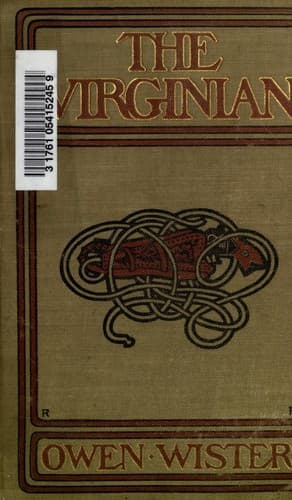
Book details and cover from Google Books.
Ready to read The Virginian?
Get your copy on Amazon, or listen to it on Audible. We earn a commission if you buy through these links.