
We earn a commission if you buy through these links. Learn more
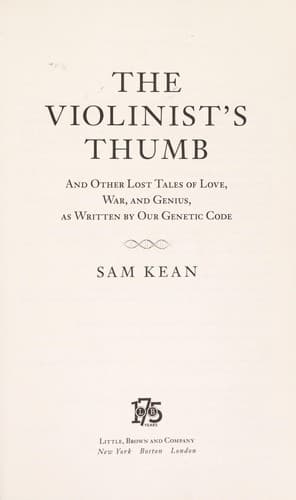
The violinist's thumb
by Sam Kean
Guide by the Books of the Day editors · Updated · How we write our guides
A lively, story-driven tour of how genetics was discovered, using odd cases and forgotten scientists to make heredity vivid for readers with no biology background.
What Creators Say About The violinist's thumb
2 creators reviewed The violinist's thumb on YouTube between 2015 and 2017, with 557 views between them. Their opinions are their own; we picked these reviews, we didn't write them.
What It's About
The Violinist's Thumb is a popular science book that tells the history of genetics as a series of human stories rather than a textbook. Sam Kean, a science writer, moves between laboratories, archives and family histories, using curious cases involving musicians, royal families and overlooked researchers to show how we came to understand heredity and DNA. The title points to one of the book's opening puzzles, a question about the unusual physical traits attributed to a famous violinist, which serves as a way into asking what genes actually do.
The approach is narrative and digressive. Each section centers on a person or a strange case, and the science arrives in pieces as the story needs it. Kean is good at making abstract mechanisms concrete, and he doesn't rush past the wrong turns, failed experiments and personal rivalries that shaped the field. The tone is chatty and playful, with plenty of quirky detail and asides that keep the pace brisk.
Reading it feels like being led through a museum of genetic oddities by a guide who clearly enjoys every exhibit. It is light on equations and heavy on anecdote, so you come away with a strong sense of how discoveries were made and who made them, more than a rigorous grasp of molecular biology. Expect breadth and entertainment over depth.
Read this if you…
- want an entertaining introduction to genetics without equations
- enjoy history of science told through vivid characters and anecdotes
- like learning odd facts you can repeat at dinner
Skip it if you…
- want a rigorous, up-to-date account of modern genomics or medicine
- prefer dense, analytical writing with citations and detailed explanations
Key Ideas
- 1
Heredity was a puzzle long before DNA
Kean shows that people spent generations guessing how traits passed between parents and children. Early ideas were often wrong, and some correct insights were ignored for decades, which makes the eventual breakthroughs feel earned rather than inevitable.
- 2
Genes are messier than textbooks suggest
The book highlights exceptions to tidy rules, such as genetic elements that move around and mutations that behave unexpectedly. These cases show that the genome is a working system full of surprises, not a simple list of instructions.
- 3
Mitochondrial DNA carries a separate family line
Kean explains how a small amount of genetic material passed down through the mother can be used to trace ancestry and identify remains. It is a useful example of how a scientific tool can move from the lab into history and forensics.
- 4
Discovery is shaped by rivalry and error
Scientific progress in these pages depends on competition, ambition, and sometimes ethically troubling choices. Kean does not present researchers as flawless heroes, which gives the history a more honest and human texture.
Limitations
The book is more a collection of linked stories than a systematic overview, so some topics feel brief and some connections feel loosely made. Readers looking for current research on gene editing, personalized medicine or population genetics will find it dated or incomplete. Some critics find the playful style gets in the way of the science, and the anecdotes occasionally outweigh explanation. Its strengths lie in storytelling rather than in offering a complete or definitive treatment of the field.
Questions Readers Ask
- Is The Violinist's Thumb good for someone new to genetics?
- Yes, it is one of the more accessible introductions to the subject. Kean explains ideas through stories and everyday comparisons, so you don't need prior biology knowledge. The main limitation is that it prioritizes narrative over systematic explanation, so you may want a more structured text afterward to fill gaps.
- How does it compare to The Gene by Siddhartha Mukherjee?
- Mukherjee's book is longer, more comprehensive and more reflective about the social and medical consequences of genetics. Kean's book is lighter and more anecdotal, focusing on surprising stories and quirky details. Choose Kean for entertainment and curiosity, and Mukherjee for a deeper, more connected history.
- Published
- 2012
- ISBN
- 9781306763837
- Difficulty
- beginner
- Category
- Science
Book details and cover from Google Books.
Ready to read The violinist's thumb?
Get your copy on Amazon, or listen to it on Audible. We earn a commission if you buy through these links.